Building a Modern AI-Powered Web Application with Django and React
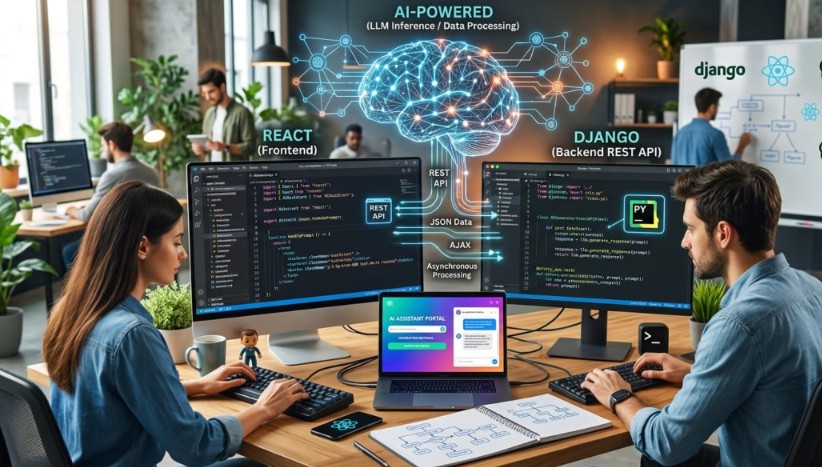
The intersection of artificial intelligence and full-stack web development has shifted from a niche domain into mainstream engineering. While AI models handle inference, reasoning, and data processing, users need reliable interfaces and secure backends to interact with them. When building production-ready AI applications, pairing Django on the backend with React on the frontend provides an optimal balance between rapid development, security, and dynamic UI responsiveness.
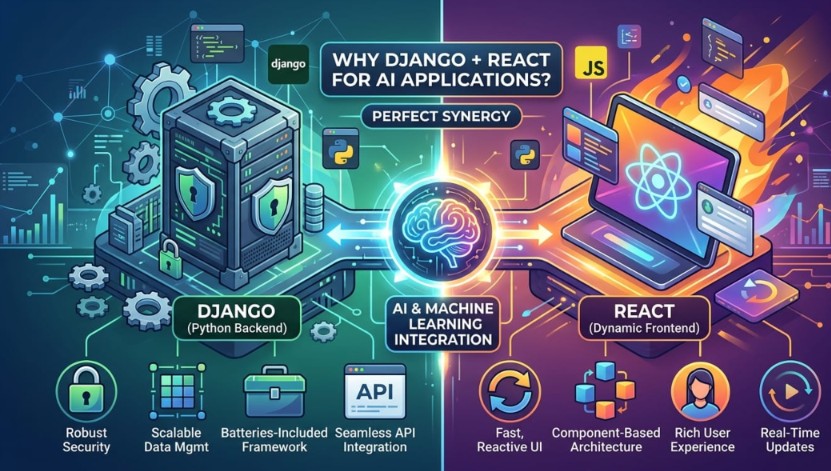
Why Django + React for AI Applications?
Modern AI apps require asynchronous processing, strict data authorization, robust API design, and real-time state updates. Here is how the stack divides responsibility:
Django (The Intelligence Hub): Django acts as the orchestrator. It handles user authentication, manages application databases, communicates with AI services (OpenAI, Hugging Face, or custom PyTorch/TensorFlow models), and manages background queues. Bacancy Technology
Django REST Framework (DRF): DRF serves as the bridge, exposing structured, secure REST endpoints or WebSockets for stream-based responses. DigitalOcean
React (The Dynamic Interface): AI outputs—such as streaming text, generated images, or interactive analytical charts—require continuous UI re-rendering. React’s component-based architecture keeps the interface reactive without full-page reloads.
Architectural Overview
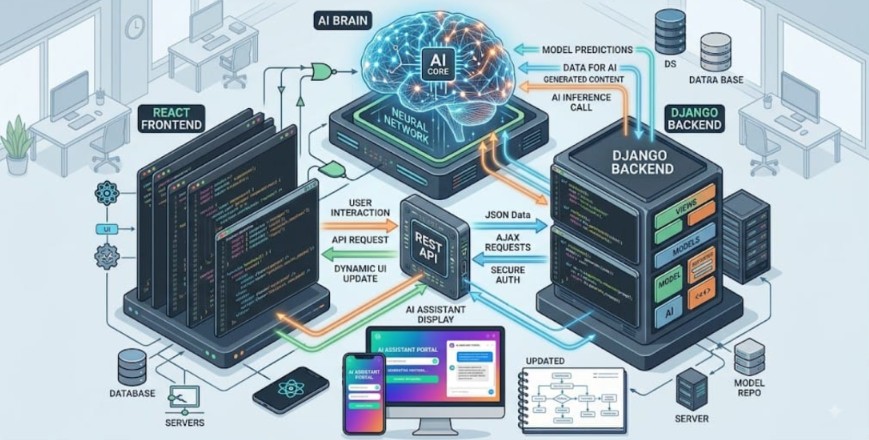
Building an AI-driven web application requires decoupling the user interface from backend intelligence and long-running background tasks.
+——————-+ REST / WebSockets +——————-+ | | <———————————-/ | | | React Frontend | | Django Backend | | (SPA Component UI)| \———————————-> | (API & ORM Core) | +——————-+ +——————-+ | Task Queue / AI Engine v +——————-+ | Celery Worker + | | LangChain / LLM | +——————-+ Frontend (React): Manages user state, interactive UI components, real-time feedback loops, and API communication via Axios or Fetch.
Backend API (Django + DRF): Handles business logic, authentication (JWT), data persistence via Django ORM, and secure API endpoints.
AI Execution Layer: Asynchronous worker processing (Celery/Redis or Django Channels) for AI inference, retrieval-augmented generation (RAG), or API calls to foundation models (OpenAI, Anthropic, Hugging Face).
Best Practices for AI Integration in Full-Stack Apps
Asynchronous Processing: For long-running AI tasks, avoid blocking Django’s HTTP request-response cycle. Delegate heavy computation to Celery workers and notify the frontend via WebSockets (Django Channels) or long polling.
Token & Cost Management: Enforce rate-limiting using Django REST Framework’s throttling features to prevent API abuse and unexpected provider costs.
Streaming Responses: For conversational AI, utilize Server-Sent Events (SSE) or WebSockets to stream LLM tokens directly to the React UI for lower perceived latency.
Security: Keep model keys server-side in Django environment variables (.env). Never expose raw API keys on the React frontend.
By mastering the integration of Python, Django, React, and cutting-edge AI services, you have acquired the complete blueprint for building modern, high-performance web applications. You now possess the skills to bridge robust backend APIs with dynamic, user-centric frontends while seamlessly executing complex artificial intelligence workloads. As AI technology continues to evolve rapidly, the full-stack foundation you’ve established in this course ensures you are well-equipped to architect scalable, intelligent solutions and stay ahead in today’s software landscape.