








How Machine Learning Supports Data Analytics
In today’s data-driven world, organizations generate vast amounts of information every second. However, raw data alone isn’t valuable—it’s what you do with it that counts. Traditionally, data analytics relied heavily on human analysis, static formulas, and manual query building. While effective for basic reporting, these methods struggle to scale with modern data volumes.
This is where Machine Learning (ML) plays a transformative role. By integrating machine learning into data analytics, businesses can automate complex tasks, uncover deeper patterns, and make highly accurate future predictions.
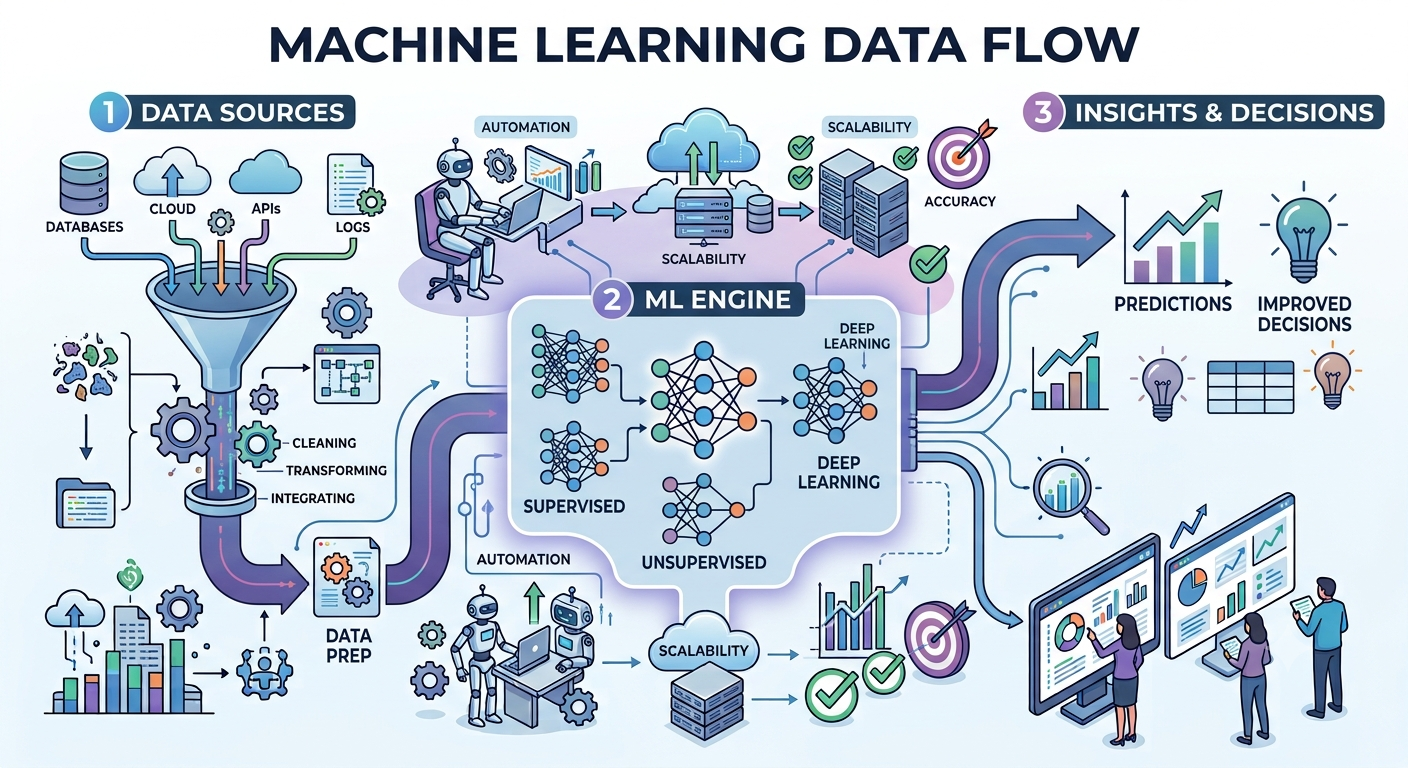
The 3-Step Machine Learning Data Flow
To understand how ML empowers data analytics, we can break the process down into three main phases:
1. Data Sources & Preparation
Before any analysis happens, data must be collected and cleaned. Machine learning helps automate data ingestion from multiple sources, including:
Databases & Cloud Storage: Aggregating structured data from SQL servers and cloud data lakes.
APIs & Logs: Streaming real-time unstructured data from mobile apps, web servers, and external services.
How ML Helps: Cleaning and transforming raw data traditionally takes up to 80% of an analyst’s time. ML algorithms automate tasks like anomaly detection in raw datasets, missing value imputation, and automated schema mapping—ensuring high-quality inputs for analysis.
2. The Machine Learning Engine
At the heart of modern analytics is the ML engine, which processes prepared data through various learning techniques:
Supervised Learning: Uses historical data with known outcomes to build models for classification (e.g., fraud vs. legitimate) and regression (e.g., price forecasting).
Unsupervised Learning: Finds hidden clusters and patterns in unlabeled data (e.g., customer segmentation or outlier detection).
Deep Learning: Uses neural networks for complex data processing, such as text analysis, image recognition, and natural language query interpretation.
Key Benefits:
Automation: Models learn and update automatically as new data comes in.
Scalability: Handles millions of rows and multi-dimensional variables effortlessly.
High Accuracy: Continuously improves predictions by evaluating model error and self-adjusting over time.
3. Insights & Decision Making
The final step translates complex model outputs into actionable business intelligence.
Predictive Analytics: Forecasting sales demand, inventory needs, or customer churn rates before they happen.
Prescriptive Recommendations: Suggesting optimal actions—such as dynamic pricing or personalized marketing engines—rather than just showing past trends.
Interactive Dashboards: Translating statistical confidence scores and predictions into clear, visual charts for decision-makers.

How Does Machine Learning Support Data Analytics?
1. Finding Patterns in Data
One of the major advantages of Machine Learning is its ability to identify patterns in large datasets.
For example, an e-commerce company can analyze customer purchasing data to discover:
- Frequently purchased products
- Customer preferences
- Seasonal buying patterns
- Popular product combinations
These patterns can help businesses understand their customers better.
2. Making Predictions
Machine Learning can use historical data to predict future outcomes.
For example, a business can use previous sales data to predict future sales.
Other examples include:
- Customer demand prediction
- Sales forecasting
- Customer churn prediction
- Stock demand forecasting
- Website traffic prediction
This allows businesses to prepare for future opportunities and challenges.
3. Automating Data Analysis
Analyzing large amounts of data manually can take considerable time. Machine Learning can automate many analytical tasks.
For example, ML can automatically:
- Categorize data
- Detect patterns
- Identify unusual behavior
- Classify customers
- Generate predictions
This allows data analysts to spend more time interpreting results and making strategic decisions.
4. Detecting Anomalies
Machine Learning can identify data points that are significantly different from normal patterns.
For example, a banking company can use ML to detect unusual transactions that may indicate fraudulent activity.
Similarly, businesses can use anomaly detection to identify:
- Unusual website activity
- Unexpected sales changes
- Suspicious transactions
- System errors
5. Customer Segmentation
Machine Learning can help businesses divide customers into different groups based on their behavior and characteristics.
For example, customers can be grouped according to:
- Purchasing behavior
- Age
- Location
- Spending habits
- Product preferences
Businesses can then create more targeted marketing campaigns for each customer group.
6. Improving Business Decisions
The ultimate goal of data analytics is to support better decision-making.
Machine Learning can transform large amounts of raw data into useful insights that help businesses decide:
- Which products to promote
- Which customers to target
- How much inventory to maintain
- Which marketing campaigns perform best
- Where business improvements are needed.
The Future of Data Analytics With Machine Learning
As businesses continue to generate more data, Machine Learning is becoming an increasingly important part of data analytics. Modern analytics is moving beyond simply understanding what happened toward understanding why it happened, what may happen next, and what actions could be taken.
Professionals who understand tools such as Excel, SQL, Python, Pandas, NumPy, Power BI, and Machine Learning can build strong skills for working with data and generating meaningful business insights.
Conclusion
Machine Learning makes Data Analytics more powerful by helping organizations find patterns, make predictions, automate analysis, detect anomalies, and make better decisions.
While traditional data analytics helps businesses understand their existing data, Machine Learning can take analysis a step further by learning from historical data and helping predict future outcomes.
In simple terms: Data Analytics helps us understand data, while Machine Learning helps us learn from that data and predict what may happen next.