








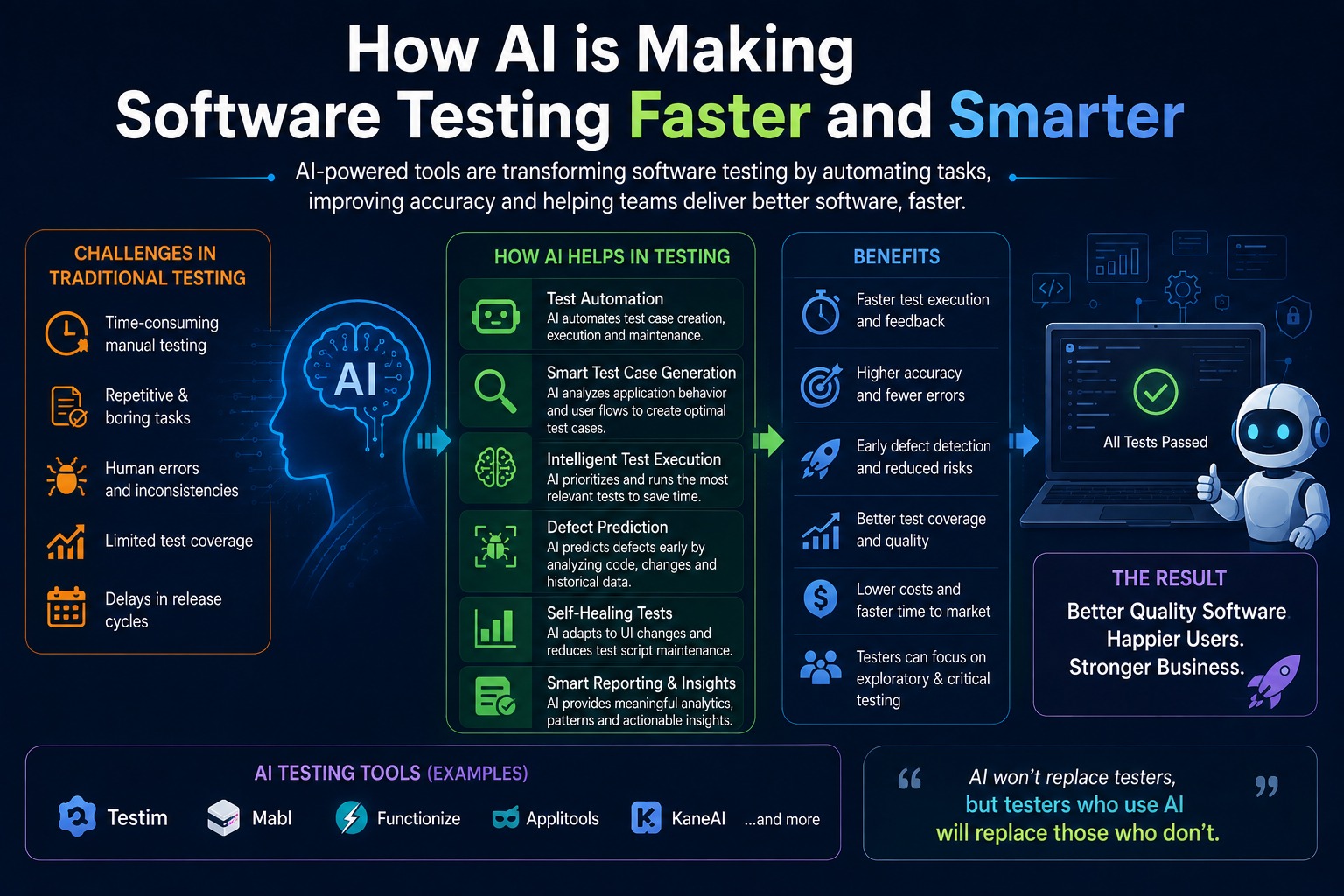
How AI is Making Software Testing Faster and Smarter
Software applications are becoming more complex every day. As businesses release new features, updates, and applications faster than ever, ensuring software quality has become a critical part of the development process.
Traditional software testing involves creating test cases, executing tests, identifying bugs, and verifying fixes. While these methods remain important, Artificial Intelligence (AI) is introducing new ways to automate repetitive tasks, analyze large amounts of testing data, identify patterns, and support testers throughout the software development lifecycle.
This is making software testing faster, more efficient, and increasingly intelligent.
What is Software Testing?
Software testing is the process of evaluating an application to determine whether it works as expected and meets its requirements.
Testing can help identify:
- Functional defects
- Performance issues
- Security vulnerabilities
- Usability problems
- Compatibility issues
- Integration errors
- Regression defects
The goal is to deliver software that is reliable, secure, and suitable for its intended use.
What is AI in Software Testing?
AI in software testing refers to the use of artificial intelligence and machine learning techniques to support or automate testing activities.
AI-powered testing tools can analyze application behavior, testing history, user interactions, and other information to assist with tasks such as:
- Test case generation
- Test execution
- Test prioritization
- Bug detection
- Test data generation
- Visual testing
- Regression testing
- Test maintenance
- Test result analysis
Instead of replacing testers completely, AI can work as an assistant that helps testers perform certain tasks more efficiently.
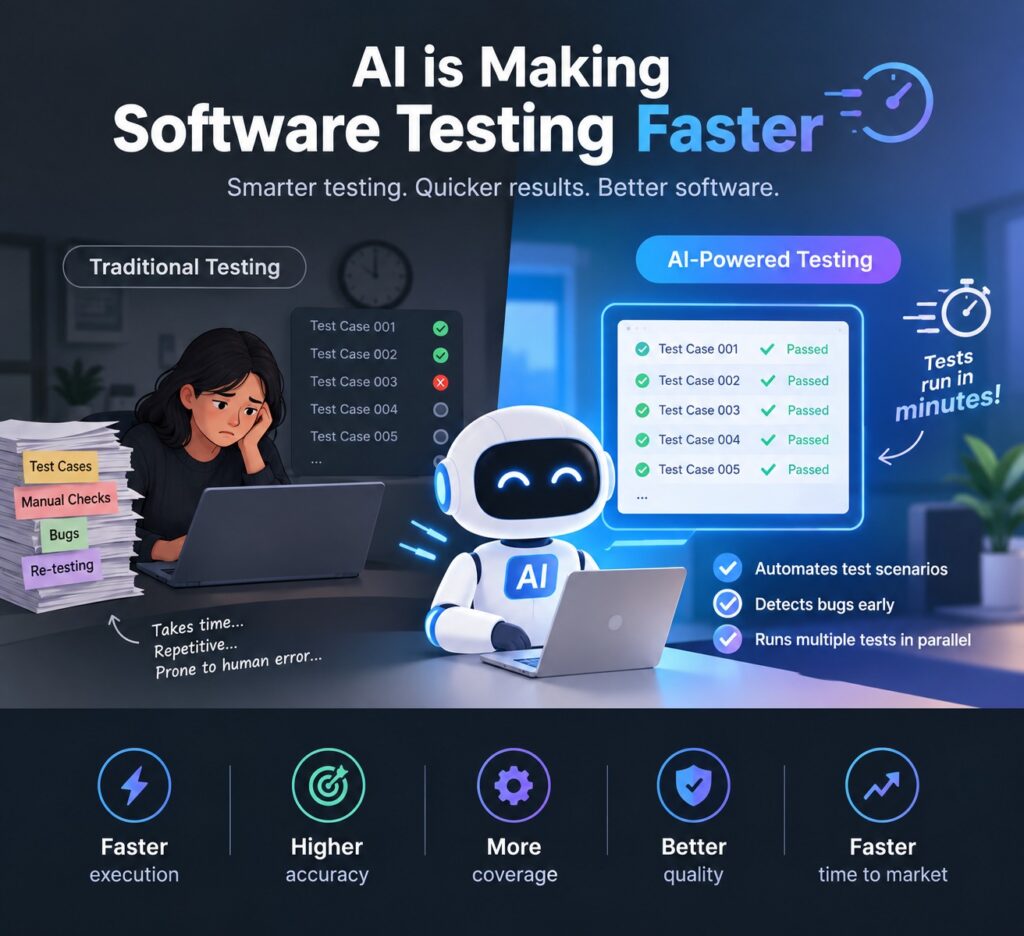
How AI is Making Software Testing Faster
1. Automated Test Case Generation
Creating test cases manually can take significant time, particularly for large applications.
AI-based tools can analyze requirements, user stories, application flows, or existing test cases and help generate potential test scenarios.
For example, for a login page, AI-assisted testing could identify scenarios such as:
- Valid username and password
- Invalid password
- Empty fields
- Incorrect email format
- Password reset
- Multiple login attempts
Testers can then review and modify the generated scenarios before using them.
2. Faster Regression Testing
Regression testing checks whether new changes have introduced problems into existing functionality.
Large applications may contain thousands of tests, making it difficult to execute every test after every change.
AI can help analyze historical test results and application changes to identify tests that are particularly relevant to the modified areas.
This can help teams prioritize testing and receive feedback sooner.
3. Intelligent Test Prioritization
Not every test has the same level of importance.
AI can analyze factors such as:
- Previous failures
- Code changes
- Application usage
- Defect history
- Test execution results
Based on these patterns, AI-assisted systems can help teams prioritize tests that may provide useful feedback earlier.
How AI is Making Software Testing Smarter
4. Intelligent Bug Detection
AI can analyze large volumes of testing information and identify patterns that may indicate defects.
For example, if a particular application feature repeatedly produces errors after certain changes, AI-assisted analysis can help identify this pattern.
This can help testers focus their attention on areas that require investigation.
5. AI-Assisted Test Data Generation
Testing often requires large amounts of test data.
Creating realistic test data manually can be time-consuming.
AI can assist in generating suitable datasets for different testing scenarios while allowing teams to define the required constraints and privacy requirements.
For example, an e-commerce application may need different customer profiles, product combinations, addresses, and transaction scenarios for testing.
6. Visual Testing
Modern applications contain many visual elements such as:
- Buttons
- Images
- Forms
- Menus
- Cards
- Dashboards
- Mobile layouts
AI-based visual testing can compare screenshots or interface states and help identify unexpected visual differences.
This can be especially useful for detecting UI problems across different browsers and screen sizes.
AI and Test Automation
Test automation is already an important part of modern software development.
Automation tools allow testers to create scripts that automatically interact with applications and verify expected results.
AI can make automation more adaptable by helping with tasks such as:
- Locating application elements
- Generating automation scripts
- Analyzing failures
- Maintaining tests after UI changes
- Identifying repetitive testing patterns
AI in Different Types of Software Testing
AI can support different testing activities.
Functional Testing
AI can help generate and analyze test scenarios to verify whether application features behave as expected.
Regression Testing
AI can help prioritize tests after application changes and analyze historical failures.
Performance Testing
AI-assisted analysis can help identify patterns in response times, resource usage, and system behavior.
Security Testing
AI can assist security teams by analyzing patterns and identifying potential areas that require further investigation. Security findings should still be validated using appropriate security testing methods.
UI Testing
Computer vision and AI-based techniques can help identify unexpected changes in application interfaces.
API Testing
AI can assist in generating test scenarios and analyzing API responses, depending on the testing platform and workflow.
AI in the Software Testing Life Cycle
AI can support several stages of the Software Testing Life Cycle.
Requirement Analysis
AI can help identify missing information, ambiguities, and potential test scenarios in requirements.
Test Planning
AI can assist in identifying testing priorities based on project information and historical data.
Test Case Design
AI can generate potential test cases from requirements and application behavior.
Test Execution
Automation frameworks can execute repetitive tests and collect results.
Defect Analysis
AI can help group similar failures and identify patterns in defect reports.
Test Reporting
AI can summarize test results and highlight important observations for testers and development teams.
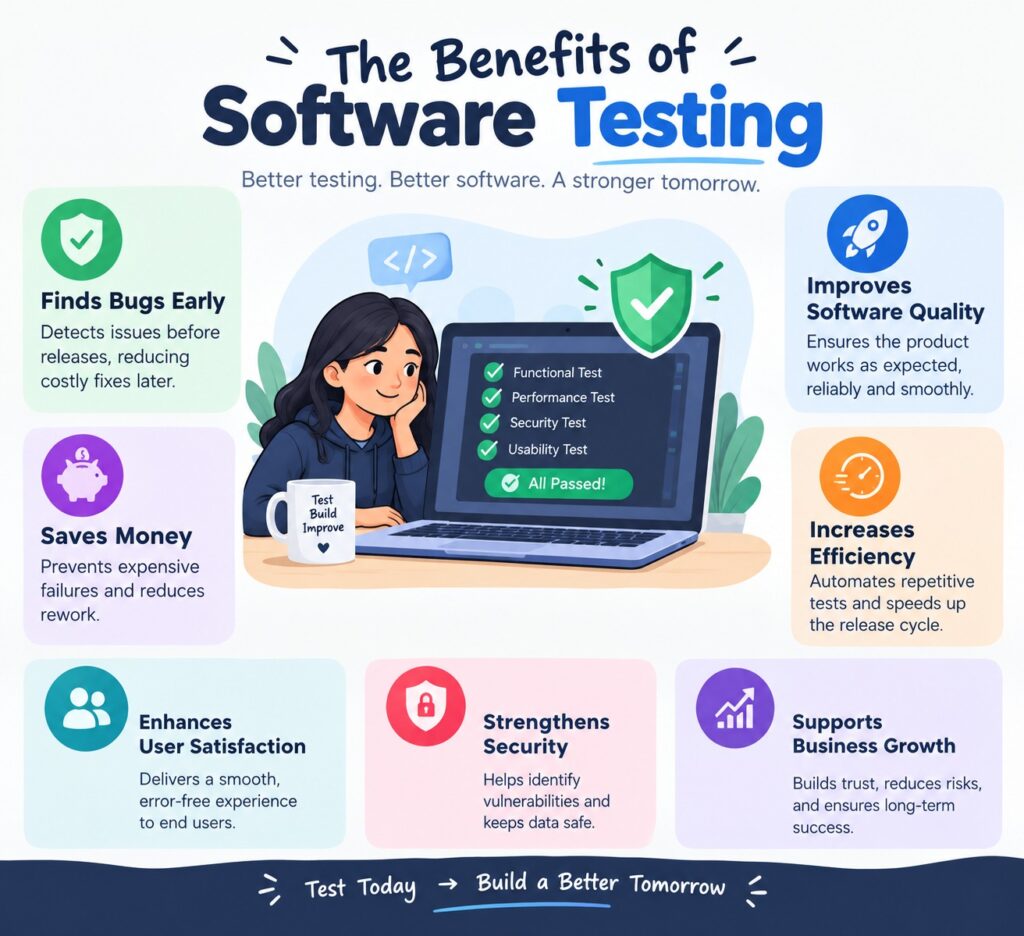
Benefits of AI in Software Testing
AI-assisted software testing can provide several benefits:
⏱ Faster Testing
Automation can reduce the time required for repetitive testing activities.
🔄 Better Regression Testing
AI can help teams focus on relevant regression scenarios after changes.
🎯 Improved Test Prioritization
Testing teams can use data-driven insights to decide which tests should receive attention first.
📊 Better Test Analysis
AI can process large volumes of test results and help identify patterns.
🛠 Reduced Test Maintenance
Some AI-assisted tools can help adapt automated tests when application interfaces change.
🚀 Faster Software Releases
When testing activities become more efficient, development teams can receive feedback earlier in the development process.
Does AI Replace Software Testers?
AI can automate and assist with many testing activities, but software testing still requires human expertise.
Testers are responsible for understanding:
- Business requirements
- User expectations
- Application risks
- Testing strategy
- Quality standards
- Unexpected user behavior
Human testers can also investigate unusual problems, evaluate usability, and make decisions based on business context.
Therefore, the future of software testing is not simply AI replacing testers. It is increasingly about testers using AI as a productivity and analysis tool.
Skills for Future Software Testers
As AI becomes more common in software development, testers can benefit from learning both traditional testing and modern AI-assisted techniques.
Important skills include:
- Manual Testing
- Test Case Design
- Functional Testing
- Regression Testing
- API Testing
- SQL and Database Testing
- Automation Testing
- Selenium or other automation frameworks
- Performance Testing
- Basic Programming
- AI-assisted Testing
- Test Management
- Bug Tracking
- Analytical Thinking
Learning these skills can help testers adapt to modern software development environments.
The Future of Software Testing with AI
The role of AI in software testing is likely to continue expanding as development teams adopt more automated and AI-assisted workflows.
AI can help testing teams move beyond simply executing predefined test cases toward more data-driven, adaptive, and intelligent testing processes.
However, effective testing still depends on good requirements, appropriate test strategies, reliable automation, and human judgment.
The most valuable approach is to combine the strengths of both:
Human Expertise + Test Automation + Artificial Intelligence = Smarter Software Testing
Conclusion
AI is changing software testing by helping teams automate repetitive activities, analyze testing data, generate potential test scenarios, prioritize tests, and identify patterns more efficiently.
From test case generation and regression testing to visual testing and defect analysis, AI can support testers throughout the software testing lifecycle.
For aspiring software testers, learning AI alongside traditional testing and automation skills can provide a strong foundation for working with modern software development teams.
The future of software testing is not just about testing faster—it is about testing smarter