








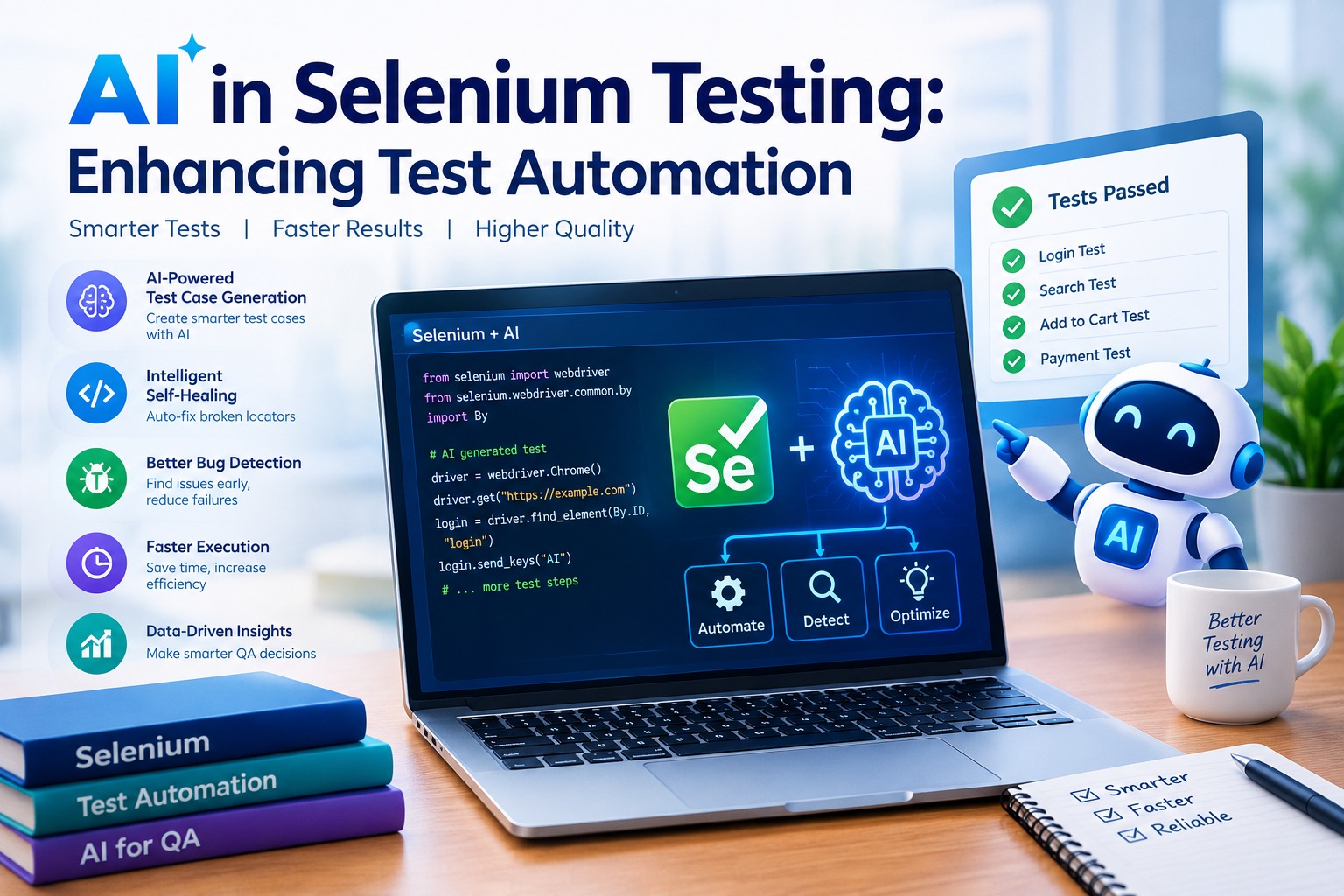
AI in Selenium Testing: Enhancing Test Automation
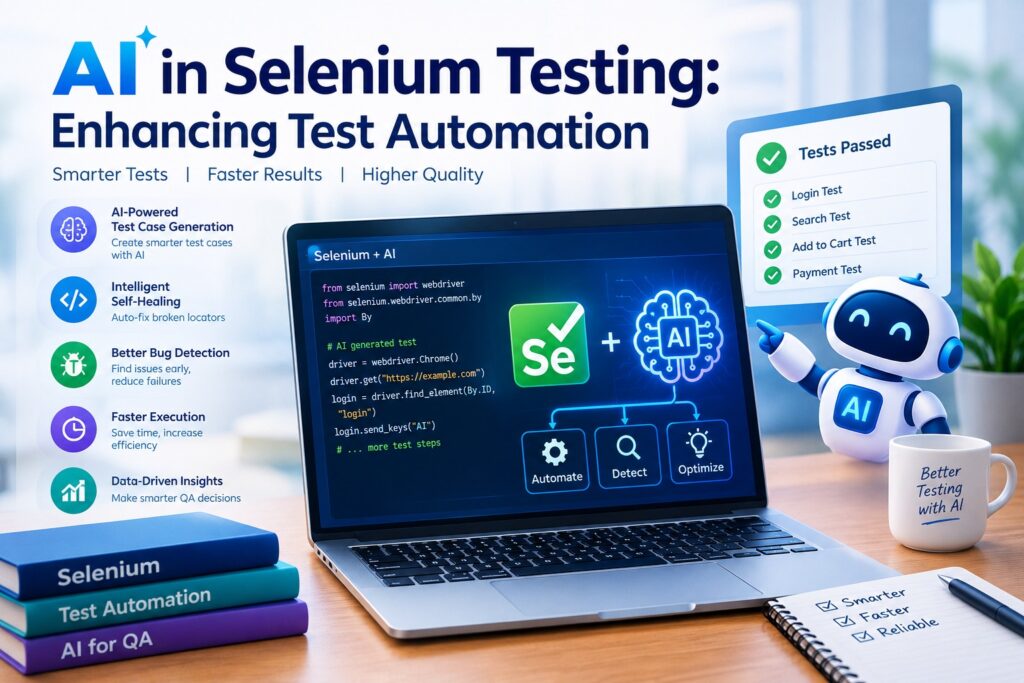
Software testing is an essential part of modern software development. As applications become more complex, testing teams need faster, smarter, and more reliable ways to identify bugs and ensure software quality. Artificial Intelligence (AI) is transforming the testing process by helping testers automate repetitive tasks, analyze test results, generate test cases, and identify potential issues more efficiently.
One of the most widely used tools for web automation is Selenium. When AI concepts and tools are combined with Selenium, testing can become more intelligent and efficient.
What Is Selenium Testing?
Selenium is an open-source framework used to automate web browsers. It allows testers to create automated tests for web applications and verify whether different features work as expected.
Selenium supports popular programming languages such as:
- Python
- Java
- C#
- JavaScript
With Selenium, testers can automate actions such as clicking buttons, entering information into forms, navigating between pages, and verifying results.
How Does AI Improve Selenium Testing?
Traditional Selenium automation usually depends on predefined test scripts. If the application’s user interface changes, these scripts may fail and require manual updates.
AI can make this process more intelligent by analyzing application behavior, test results, and patterns.
1. AI-Powered Test Case Generation
Creating test cases can take considerable time, especially for large applications. AI can analyze requirements, user flows, and application behavior to suggest relevant test scenarios.
For example, for an e-commerce website, AI can help identify scenarios such as:
- User login
- Product search
- Product filtering
- Add to cart
- Checkout
- Payment
- Logout
These scenarios can then be converted into automated Selenium tests.
2. Smarter Test Data Generation
Testing often requires different types of input data. AI can assist testers in generating realistic test data for different scenarios.
For example, AI can help create:
- Valid user information
- Invalid login credentials
- Different product combinations
- Boundary-value inputs
- Negative test data
This can reduce the amount of manual effort required to prepare test data.
3. Self-Healing Test Automation
One of the challenges with Selenium is that test scripts can break when web elements change.
For example, a Selenium script may identify a button using a particular ID. If that ID changes after a website update, the test may fail.
AI-based testing approaches can analyze alternative properties or patterns of the element and help identify the updated element. This concept is often called self-healing automation.
It can reduce maintenance effort and make automated tests more resilient to UI changes.
4. Intelligent Bug Detection
AI can analyze large amounts of test data and identify unusual patterns that may indicate defects.
Instead of simply reporting that a test failed, AI-assisted systems can help testers investigate:
- Where the failure occurred
- What changed
- Which tests are affected
- Whether similar failures occurred previously
This can help QA teams identify problems more quickly.
5. Faster Test Execution
Large applications may contain thousands of automated test cases. Running every test after every software change can take significant time.
AI can help prioritize tests based on factors such as:
- Recent code changes
- Previous failures
- Risk levels
- Frequently used application features
This allows teams to focus testing efforts on the areas that are more likely to contain problems.
AI + Selenium: A Practical Example
Imagine an online shopping website with a login page.
A traditional Selenium test might perform the following steps:
- Open the website.
- Enter the username.
- Enter the password.
- Click the Login button.
- Verify that the dashboard appears.
With AI-assisted testing, additional intelligence can be introduced into the process. AI could help generate different login scenarios, identify relevant test cases, analyze failures, and suggest improvements when the interface changes.
This combination allows Selenium to remain the automation engine while AI provides additional intelligence around the testing process.
Benefits of AI-Powered Selenium Testing
Combining AI with Selenium can provide several benefits:
Increased efficiency: Automates repetitive testing activities and reduces manual effort.
Better test coverage: AI can help identify additional scenarios that testers may overlook.
Reduced maintenance: Intelligent approaches can help handle certain changes in web elements and application interfaces.
Faster bug identification: AI can analyze test failures and patterns more efficiently.
Improved productivity: Testers can spend more time on exploratory testing, test strategy, and complex quality-assurance activities.
Data-driven decisions: Test results and historical data can be analyzed to support better testing decisions.
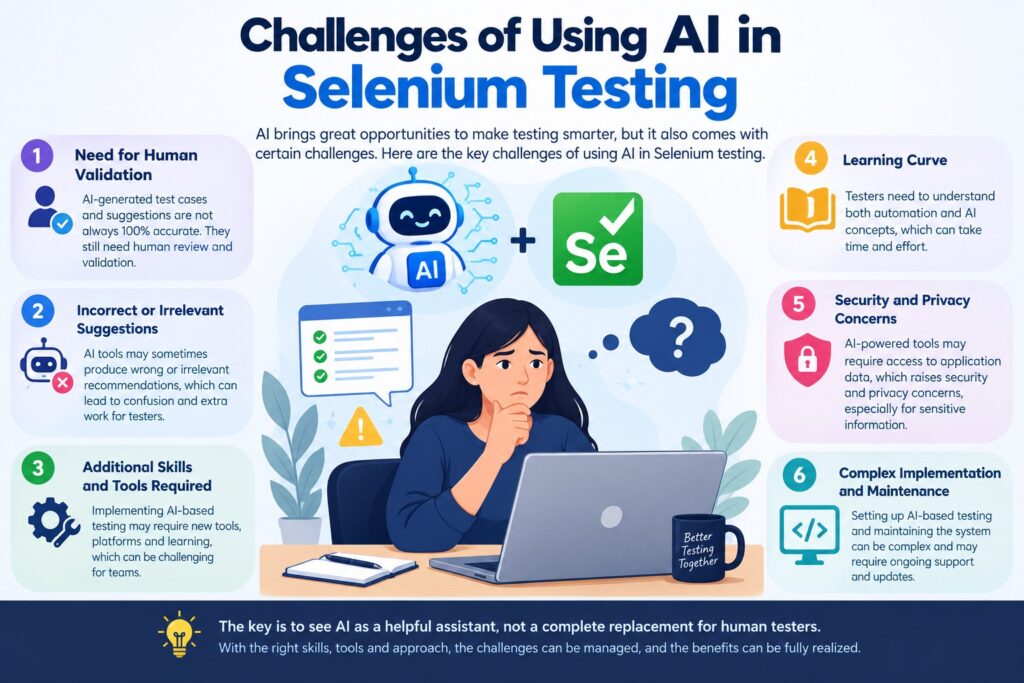
Challenges of Using AI in Selenium Testing
Although AI offers many advantages, it does not completely replace the role of a software tester.
Some challenges include:
- AI-generated test cases still need human validation.
- AI tools may sometimes produce incorrect or irrelevant suggestions.
- Implementing AI-based testing can require additional skills and tools.
- Testers need to understand both automation and AI concepts.
- Security and privacy should be considered when testing with AI-powered tools.
Therefore, the best approach is to use AI as an assistant for testers, rather than relying on it without human supervision.
The Future of AI in Software Testing
The future of software testing is moving toward intelligent automation. AI can help QA professionals analyze applications, generate test scenarios, prioritize testing, detect patterns, and improve automation workflows.
Selenium remains an important skill for web test automation, while knowledge of AI can help testers adapt to the changing testing environment.
Professionals who understand Manual Testing + Selenium + Automation + AI can develop a valuable combination of skills for modern QA roles.
Conclusion
AI is changing the way software testing is performed. When combined with Selenium, it can help make automated testing smarter, faster, and more adaptable.
From generating test cases and test data to analyzing failures and supporting self-healing automation, AI can reduce repetitive work and help testers focus on improving software quality.
Learning Selenium along with AI concepts can therefore be a strong step for anyone looking to build a career in modern software testing and quality assurance.
The future of testing is not just automation — it is intelligent automation.