








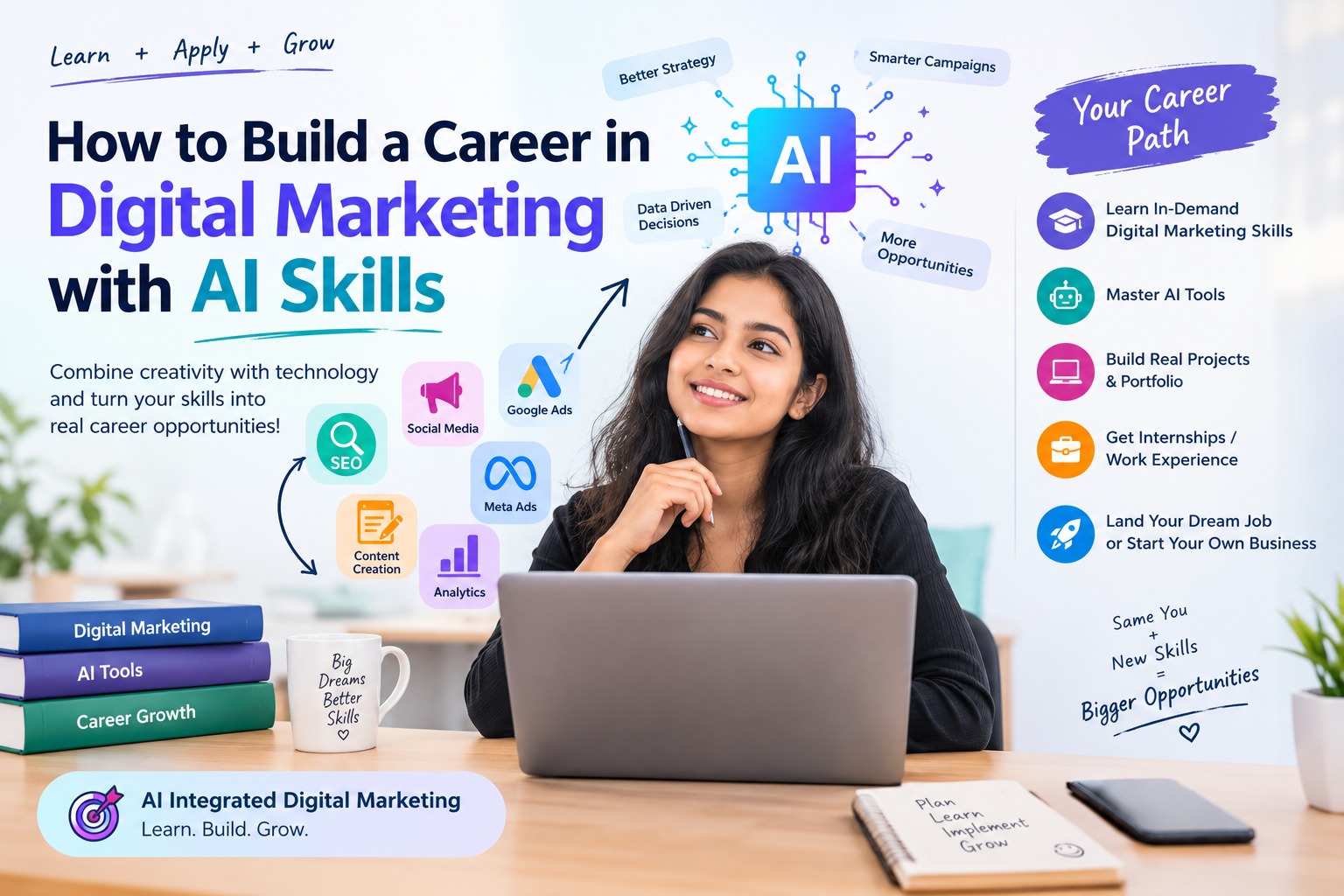
How to Build a Career in Digital Marketing with AI Skills
Digital marketing has become one of the most important parts of modern business. As more companies move their marketing activities online, the demand for skilled digital marketers continues to grow. At the same time, Artificial Intelligence (AI) is changing how marketers create content, analyze data, run advertisements, understand customers, and develop marketing strategies.
Learning Digital Marketing with AI skills can help beginners and professionals become more efficient, creative, and competitive in the modern job market.
What Is AI-Integrated Digital Marketing?
AI-integrated digital marketing combines traditional digital marketing techniques with Artificial Intelligence tools and technologies.
Digital marketing includes areas such as:
- Search Engine Optimization (SEO)
- Social Media Marketing
- Content Marketing
- Google Ads
- Meta Ads
- Email Marketing
- Google Analytics
- Google Business Profile
- Marketing strategy and analytics
AI can support these activities by helping marketers generate content ideas, research keywords, create advertisements, analyze customer behavior, automate repetitive tasks, and make data-driven decisions.
Why Are AI Skills Important for Digital Marketers?
AI does not replace the need for digital marketers. Instead, it can help marketers work faster and make better-informed decisions.
For example, AI tools can help with:
- Generating content ideas
- Creating social media captions
- Developing advertising copy
- Keyword research
- Competitor analysis
- Customer segmentation
- Data analysis
- Campaign optimization
- Marketing automation
- Creating images and other creative assets
A marketer who understands both marketing fundamentals and AI tools can use technology more effectively while still applying creativity, strategy, and human judgment.
Step 1: Learn the Fundamentals of Digital Marketing
Before using AI tools, it is important to understand the basics of digital marketing.
Start by learning:
SEO
Learn how search engines work, keyword research, on-page SEO, technical SEO, link building, website optimization, and performance monitoring.
Social Media Marketing
Understand how businesses use platforms such as Instagram, Facebook, LinkedIn, and YouTube to build their brand and connect with customers.
Paid Advertising
Learn how Google Ads and Meta Ads work, including campaign objectives, audience targeting, budgets, bidding, ad copy, creatives, and performance metrics.
Content Marketing
Learn how to create useful and engaging content for websites, blogs, social media, and other digital platforms.
Analytics
Understand important marketing metrics and learn how to measure traffic, engagement, leads, conversions, and campaign performance.
Step 2: Develop AI Skills
Once you understand digital marketing fundamentals, start learning how AI can support different marketing activities.
AI tools can help marketers move from simply creating content to developing smarter marketing strategies.
For example, instead of manually creating multiple ad-copy variations, marketers can use AI to generate different ideas and then evaluate and improve them based on the target audience and campaign objective.
The important skill is not simply knowing how to use an AI tool. The real advantage comes from knowing what to ask, how to evaluate the result, and how to apply it to a marketing goal.
Step 3: Learn AI for Content Creation
Content creation is one of the areas where AI can save marketers significant time.
AI can assist with:
- Blog topic generation
- Social media captions
- Content outlines
- Ad copy
- Email drafts
- Video scripts
- Product descriptions
- Content repurposing
However, AI-generated content should always be reviewed and improved by a human. Adding brand personality, originality, accurate information, and audience-specific insights makes the content more valuable.
Step 4: Use AI for SEO
AI can become a useful assistant for SEO professionals.
Marketers can use AI to support:
- Keyword research
- Search intent analysis
- Content planning
- Topic clustering
- Meta title ideas
- Meta description ideas
- Content optimization
- Competitor research
- SEO audits
For example, an AI tool can help generate a list of content topics around a target keyword. The marketer can then evaluate search intent, competition, business relevance, and audience needs before creating the final content strategy.
Step 5: Combine AI with Paid Advertising
AI is also changing online advertising.
Digital marketers can use AI to support:
- Ad-copy generation
- Audience research
- Creative ideas
- Campaign analysis
- Performance optimization
- A/B testing ideas
- Budget planning
- Customer segmentation
For Google Ads and Meta Ads, marketers still need to understand campaign objectives, targeting, budgets, bidding strategies, conversion tracking, and performance metrics.
AI should be treated as a marketing assistant, while the marketer remains responsible for strategic decisions.
Step 6: Learn Data Analytics
Successful digital marketing is not only about creating attractive content. It is also about understanding results.
A digital marketer should learn how to analyze:
- Website traffic
- Click-through rate (CTR)
- Conversion rate
- Cost per click (CPC)
- Cost per acquisition (CPA)
- Engagement rate
- Leads
- Sales
- Return on advertising spend (ROAS)
AI can help identify patterns in marketing data and summarize large amounts of information. This allows marketers to spend more time making strategic decisions.
Step 7: Build Real Projects
One of the best ways to develop digital marketing skills is through practical projects.
Create projects such as:
- SEO audit for a website
- Social media marketing plan
- Google Ads campaign plan
- Meta Ads campaign
- Content calendar
- Email marketing campaign
- Google Business Profile optimization
- Website analytics report
- AI-powered marketing strategy
Real projects give you something valuable to show employers and clients.
Step 8: Create a Strong Portfolio
A portfolio can demonstrate your skills more effectively than simply listing them on a resume.
Your portfolio can include:
SEO Project:
Keyword research, website audit, on-page optimization, and SEO recommendations.
Social Media Project:
Content calendar, social media posts, captions, and campaign strategy.
Paid Advertising Project:
Google Ads or Meta Ads campaign structure, audience targeting, ad copy, and performance analysis.
AI Marketing Project:
Show how AI was used for content ideas, ad copy, research, analysis, or campaign planning.
A strong portfolio demonstrates not only what tools you know, but also how you use those tools to solve marketing problems.
Step 9: Develop Soft Skills
Technical knowledge alone is not enough for a successful digital marketing career.
Develop skills such as:
- Communication
- Creativity
- Problem-solving
- Presentation
- Time management
- Critical thinking
- Teamwork
- Adaptability
AI can generate information quickly, but marketers need human skills to understand customers, communicate ideas, and make strategic decisions.
Step 10: Keep Learning
Digital marketing changes constantly. New platforms, AI tools, advertising features, search technologies, and marketing trends continue to emerge.
Successful marketers should develop a habit of continuous learning.
Follow industry updates, experiment with new tools, work on practical projects, and regularly improve your skills.
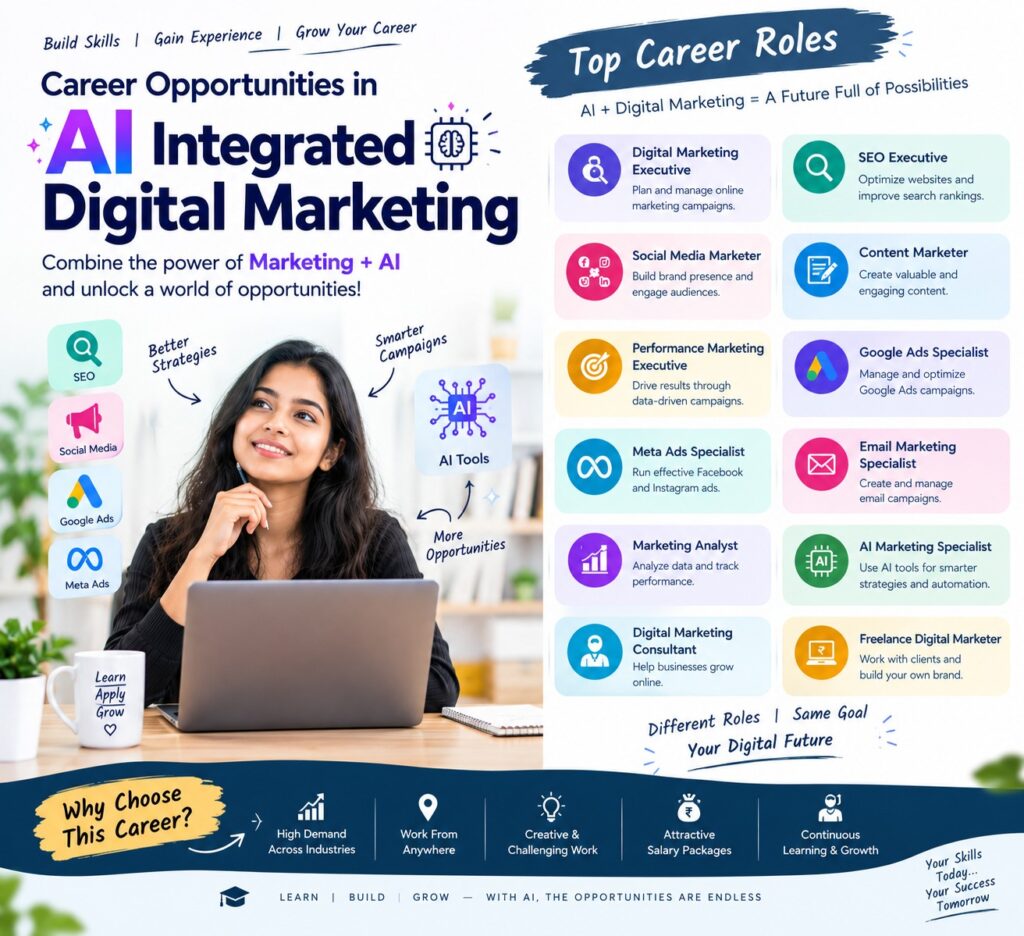
Career Opportunities in AI-Integrated Digital Marketing
Learning digital marketing along with AI can open opportunities in different roles, including:
- Digital Marketing Executive
- SEO Executive
- Social Media Marketer
- Content Marketer
- Performance Marketing Executive
- Google Ads Specialist
- Meta Ads Specialist
- Email Marketing Specialist
- Marketing Analyst
- AI Marketing Specialist
- Digital Marketing Consultant
- Freelance Digital Marketer
You can also use these skills to promote your own business or work with clients as a freelancer.
Final Thoughts
The future of digital marketing will not simply belong to people who know traditional marketing or people who know AI tools. It will increasingly favor professionals who can combine marketing knowledge, technology, creativity, and strategic thinking.
If you are planning to start a career in digital marketing, begin with the fundamentals, learn how AI can support your work, practice with real projects, build a portfolio, and continue learning.
Digital Marketing + AI Skills = Smarter Work, Better Strategies, and More Career Opportunities.
The goal is not to let AI do everything. The goal is to learn how to use AI effectively to become a better digital marketer.