








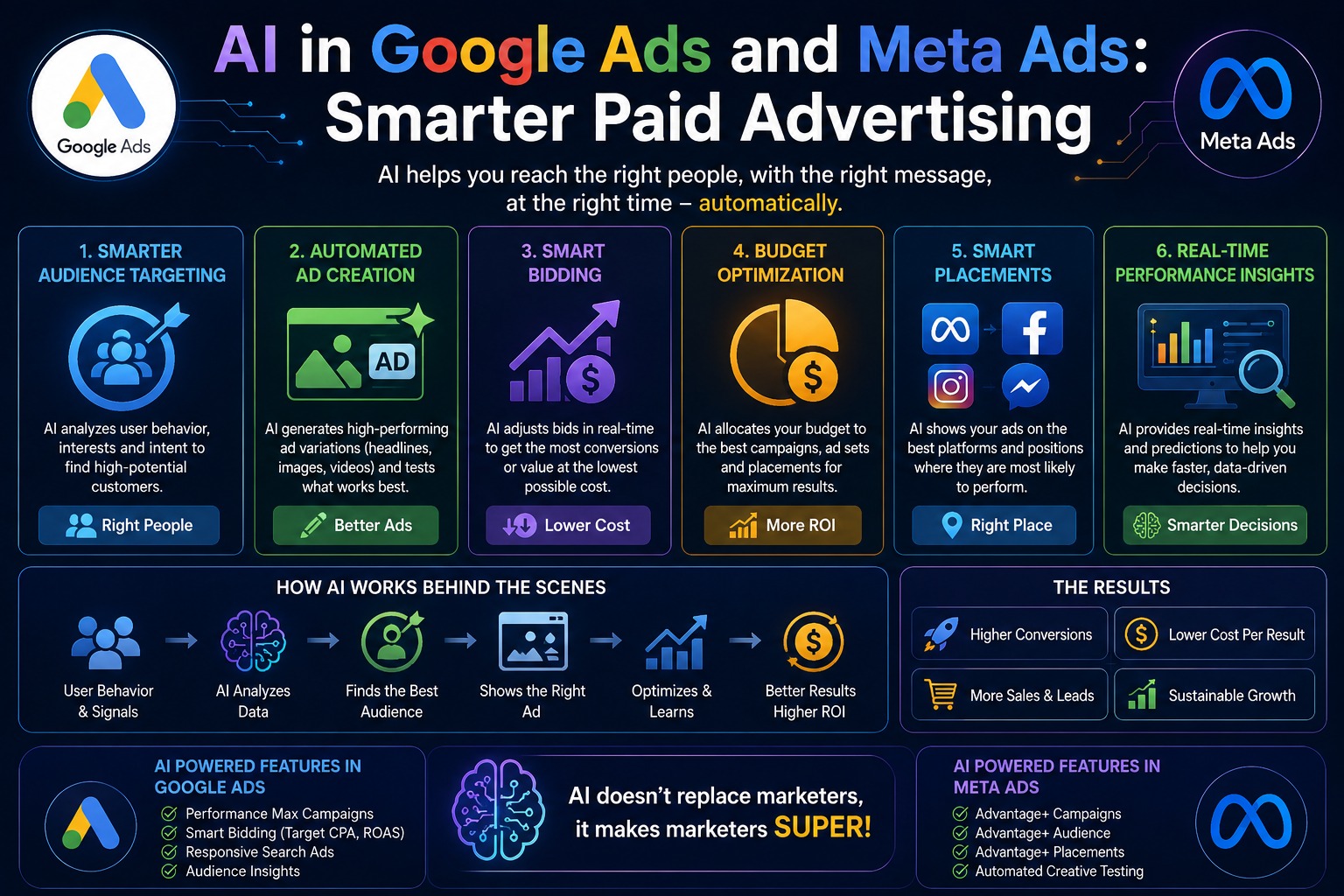
AI in Google Ads and Meta Ads: Smarter Paid Advertising
Paid advertising has become an important part of digital marketing. Businesses use platforms such as Google Ads and Meta Ads to reach potential customers, promote products and services, generate leads, and increase sales.
As advertising platforms become more advanced, Artificial Intelligence (AI) is playing an increasingly important role in campaign creation, audience targeting, bidding, optimization, and performance analysis.
AI can help marketers process large amounts of advertising data and automate certain decisions. However, successful advertising still depends on good strategy, relevant creative content, accurate tracking, and human oversight.
What is AI in Digital Advertising?
AI in digital advertising refers to the use of machine learning, automation, and intelligent systems to help marketers manage and optimize advertising campaigns.
AI can assist with tasks such as:
- Audience targeting
- Automated bidding
- Budget optimization
- Ad placement
- Creative recommendations
- Performance analysis
- Conversion optimization
- Campaign forecasting
Instead of manually managing every advertising decision, marketers can use AI-powered features to automate repetitive tasks while focusing on strategy and creative direction.
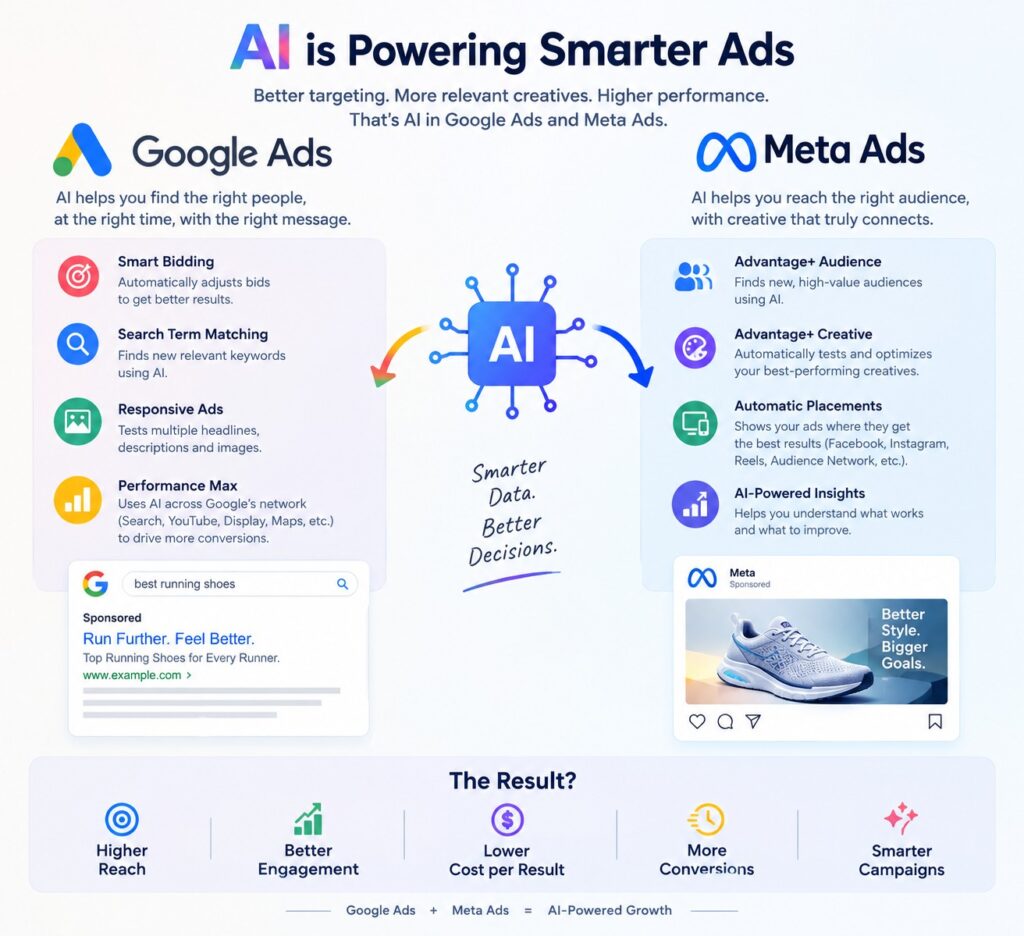
AI in Google Ads
Google Ads uses machine learning across several campaign features to help advertisers reach relevant audiences and optimize toward selected campaign goals.
1. Smart Bidding
One of the important applications of AI in Google Ads is Smart Bidding.
Smart Bidding uses machine learning to optimize bids based on signals that can influence the likelihood of a conversion.
Depending on the campaign objective, advertisers can use strategies such as:
- Maximize Conversions
- Maximize Conversion Value
- Target CPA
- Target ROAS
For example, an e-commerce business may use Target ROAS when its goal is to optimize advertising toward a desired return on ad spend.
2. Performance Max
Performance Max is a Google Ads campaign type that uses Google’s automated systems to help advertisers reach customers across multiple Google channels from a single campaign.
Depending on eligibility and campaign setup, ads can appear across surfaces such as:
- Google Search
- YouTube
- Display
- Discover
- Gmail
- Google Maps
Advertisers provide campaign goals, creative assets, audience signals, and other inputs, while Google’s systems use machine learning to help optimize delivery.
3. AI-Assisted Ad Creation
AI-powered features can assist marketers with generating or improving advertising assets such as headlines, descriptions, and other creative elements.
For example, a digital marketer promoting a digital marketing course could use AI to brainstorm different headline variations before reviewing and refining them for the target audience.
Human review remains important to ensure that the final advertising copy is accurate, relevant, and aligned with the brand.
4. Audience and Conversion Signals
AI-powered advertising systems can analyze signals related to user behavior, context, and conversions to help determine when and where ads should be shown.
This can help marketers reach people who are more likely to take a desired action.
However, accurate conversion tracking is essential. If conversions are not configured correctly, automated optimization may work toward incomplete or misleading signals.
AI in Meta Ads
Meta’s advertising platforms also use machine learning to help advertisers with audience selection, delivery, placements, and campaign optimization.
Meta Ads can be used across platforms such as:
1. Automated Audience Optimization
Meta’s advertising systems can use machine learning to identify people who may be more likely to take the desired action based on the campaign objective and available signals.
Advertisers can provide targeting inputs, while Meta’s systems can help optimize delivery.
This can be particularly useful when the potential audience is large and complex.
2. Advantage+ Campaign Features
Meta provides Advantage+ features that use automation and machine learning across different parts of advertising campaigns.
Depending on the campaign type, these features can assist with:
- Audience
- Placements
- Creative
- Budget and delivery
- Campaign optimization
The exact options available can vary by campaign objective and account.
3. AI-Assisted Creative
AI can help marketers develop advertising ideas and variations for:
- Primary text
- Headlines
- Images
- Videos
- Calls to action
For example, a business selling handmade products could create multiple versions of an ad message and test which creative approach generates stronger engagement or conversions.
AI can speed up the idea-generation process, but marketers should still check brand voice, accuracy, and customer relevance.
4. Automated Placements
Meta can use machine learning to determine suitable placements for ads across its available inventory.
Depending on the campaign setup, this can help advertisers reach people across different locations within Meta’s ecosystem without manually selecting every placement.
How AI Makes Paid Advertising Smarter
AI can improve several parts of the advertising workflow.
Faster Campaign Management
Automation can reduce the amount of manual work involved in bidding, targeting, and campaign optimization.
Better Use of Data
AI can process large amounts of campaign data and identify patterns that may be difficult to evaluate manually.
More Efficient Testing
Marketers can create multiple creative and messaging variations and evaluate their performance using measurable campaign results.
Automated Optimization
Machine learning systems can continuously adjust certain campaign settings based on available signals and selected objectives.
Improved Personalization
Advertising systems can use available signals to help deliver ads to audiences that are more relevant to the campaign objective.
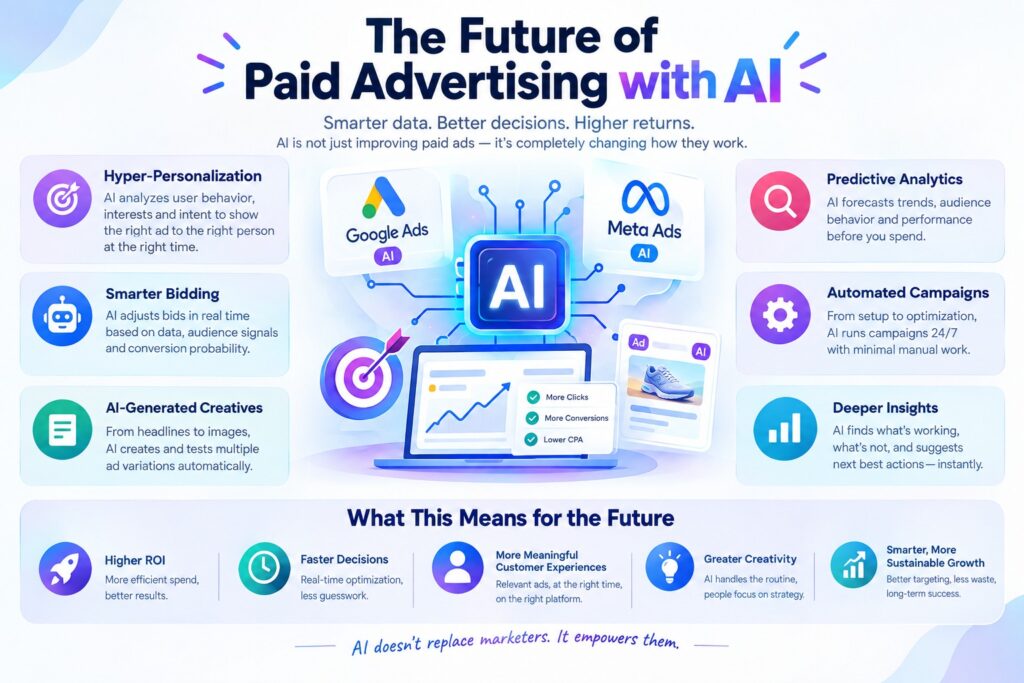
The Future of Paid Advertising with AI
AI is changing the way digital advertising campaigns are created and optimized.
Instead of manually controlling every campaign setting, marketers are increasingly working with automated systems that can process large amounts of data and optimize toward specific objectives.
The role of the marketer is therefore evolving from simply managing campaign settings to becoming a strategist, analyst, creative thinker, and AI-assisted decision-maker.
The future of paid advertising can be summarized as:
Human Strategy + Creative Thinking + Quality Data + AI Automation = Smarter Advertising
Conclusion
AI is making Google Ads and Meta Ads more automated and data-driven.
From Smart Bidding and Performance Max in Google Ads to Advantage+ and automated optimization in Meta Ads, AI can help marketers manage campaigns, analyze signals, optimize delivery, and test creative ideas more efficiently.
However, AI works best when combined with accurate tr