








From Data to Decisions: The Role of AI in Data Analytics
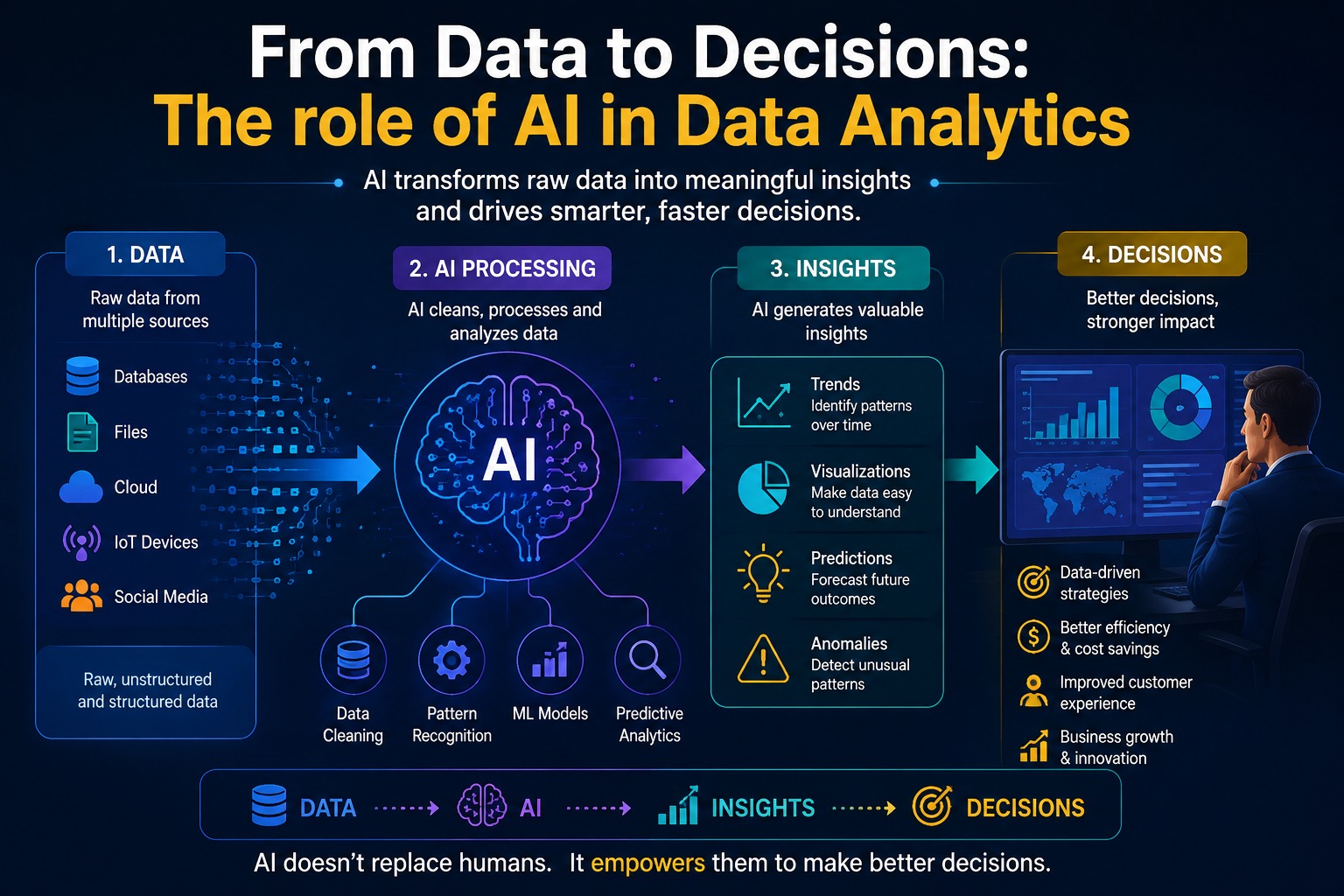
In today’s digital world, businesses generate enormous amounts of data every day. From customer behavior and sales transactions to website traffic and social media engagement, data has become one of the most valuable resources for modern organizations. However, collecting data is only the beginning. The real challenge is turning that data into meaningful insights and making better decisions.
This is where Artificial Intelligence (AI) is transforming the field of Data Analytics.
How Does AI Help in Data Analytics?
AI uses technologies such as machine learning, natural language processing, and automation to analyze large amounts of information and identify patterns that may not be immediately visible to humans.
Here are some important ways AI supports data analytics:
1. Automated Data Processing
AI can help automate repetitive data-related tasks such as organizing datasets, identifying missing values, detecting duplicates, and preparing data for analysis.
This allows data analysts to spend more time focusing on insights rather than performing repetitive tasks.
2. Finding Hidden Patterns
Large datasets can contain complex relationships that are difficult to identify manually. AI and machine learning algorithms can analyze large volumes of data and detect patterns, trends, and relationships.
For example, a business can analyze customer purchasing behavior to identify which products are frequently purchased together.
3. Predictive Analytics
One of the most valuable applications of AI in data analytics is predictive analysis.
AI models can use historical data to identify patterns and generate predictions about possible future outcomes.
Businesses can use predictive analytics for:
- Sales forecasting
- Customer demand prediction
- Customer churn analysis
- Risk assessment
- Inventory planning
- Marketing performance analysis
4. Faster Decision-Making
AI-powered analytics can process large amounts of data much faster than traditional manual methods. This enables businesses to obtain insights quickly and respond to changing market conditions.
For example, an e-commerce company can analyze sales and customer data to identify which products are performing well and adjust its marketing strategy accordingly.
5. Intelligent Data Visualization
Data visualization makes complex information easier to understand through charts, graphs, and dashboards.
AI can assist analysts in identifying important trends and generating meaningful visual insights. Tools such as Power BI and other modern analytics platforms can help transform raw data into interactive dashboards and reports.
AI and Machine Learning in Data Analytics
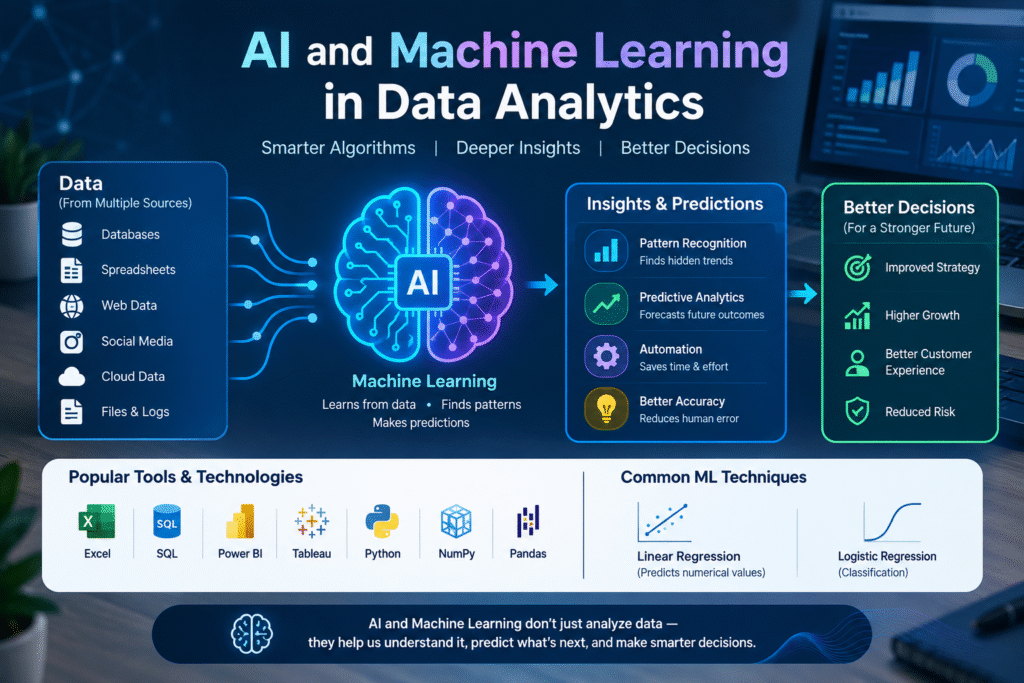
Machine Learning (ML) is an important part of AI-powered data analytics.
Instead of explicitly programming a computer for every possible situation, machine learning algorithms can learn patterns from existing data and use those patterns to make predictions or classifications.
For example, a business can use machine learning to predict whether a customer is likely to stop using its service based on previous customer behavior.
Two commonly used machine learning techniques include:
Linear Regression
Linear Regression is commonly used to understand relationships between variables and predict numerical values.
For example, it can be used to estimate future sales based on historical sales data.
Logistic Regression
Logistic Regression is commonly used for classification problems.
For example, it can help predict whether a customer is likely to purchase a product or whether a transaction may belong to a particular category.
Popular Tools Used in Data Analytics with AI
A modern data analyst may work with several tools and technologies depending on the organization’s requirements.
Some commonly used tools include:
- Microsoft Excel – Data cleaning, analysis, formulas, and reporting
- SQL – Working with and querying databases
- Power BI – Data visualization and interactive dashboards
- Tableau – Business intelligence and data visualization
- Python – Data analysis and automation
- NumPy – Numerical computing with Python
- Pandas – Data manipulation and analysis
- Machine Learning – Predictive analytics and intelligent decision-making
- AI Tools – Assistance with analysis, insights, reporting, and automation
Real-World Example: How AI Turns Data into Decisions
Imagine an online retail company has thousands of customer transactions.
The company collects information such as:
- Customer age
- Products purchased
- Purchase frequency
- Order value
- Location
- Website activity
Instead of simply storing this information, the company can use data analytics and AI to discover useful insights.
AI-powered analysis might help identify customers who are likely to make another purchase, products that are likely to experience increased demand, or customers who may stop purchasing.
The business can then use these insights to make decisions about marketing campaigns, product recommendations, inventory, and customer retention.
This demonstrates the journey:
Raw Data → Data Analysis → AI Insights → Business Decisions
Benefits of AI-Powered Data Analytics
Combining AI with data analytics can provide several benefits:
- Faster analysis
- Automation of repetitive tasks
- Better pattern detection
- Improved forecasting
- Data-driven decision-making
- Improved business efficiency
- Personalized customer experiences
- Ability to analyze large datasets
- Better understanding of business performance
However, AI does not completely replace the role of a data analyst. Human judgment remains important for understanding business context, validating results, considering ethical issues, and deciding how insights should be used.
Skills Needed for a Data Analytics Career
For students interested in becoming data analysts, developing a combination of technical and analytical skills is valuable.
Important skills include:
- Excel
- SQL
- Data Visualization
- Power BI or Tableau
- Python
- NumPy
- Pandas
- Statistics
- Machine Learning
- AI-assisted Data Analysis
- Problem-Solving
- Business and Communication Skills
Learning these skills can help students understand the complete data analytics workflow—from collecting and preparing data to analyzing it and communicating insights.
The Future of Data Analytics with AI
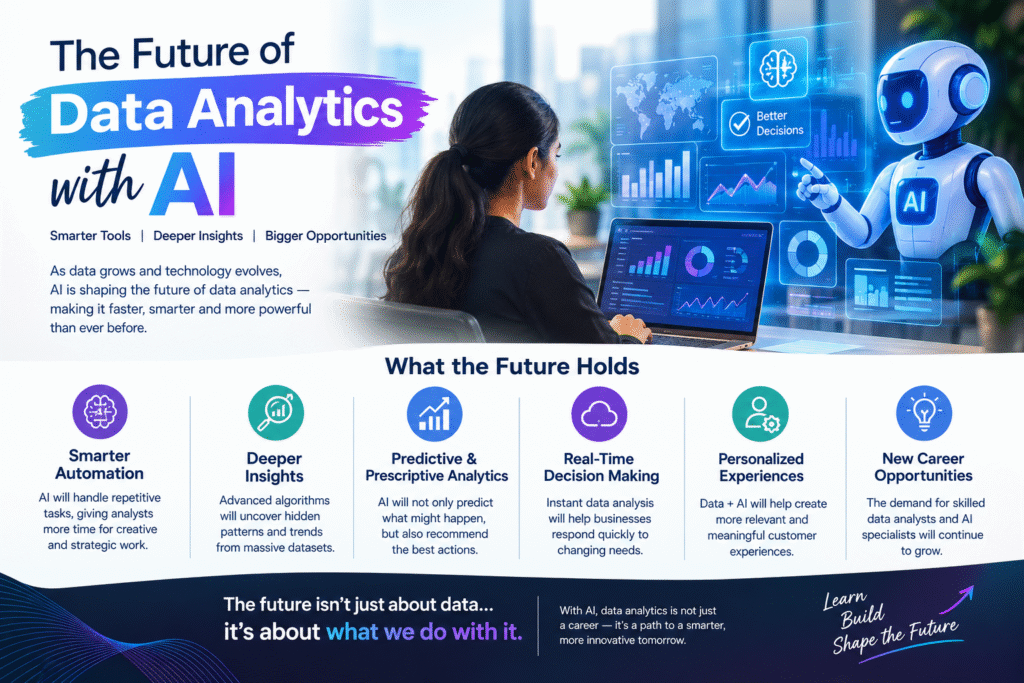
AI is becoming an increasingly important part of modern data analytics. As organizations continue to generate more data, the ability to analyze information quickly and turn it into actionable insights will remain valuable.
Future data analysts will increasingly work alongside AI-powered tools. Instead of spending all their time on repetitive data-processing tasks, analysts can focus more on asking meaningful questions, interpreting results, and helping businesses make informed decisions.
Conclusion
The journey from data to decisions is becoming more powerful with Artificial Intelligence.
Data analytics helps businesses understand what has happened and why, while AI can help identify patterns, automate analysis, and support predictions about what may happen next.
By combining Excel, SQL, Power BI, Python, Pandas, NumPy, Machine Learning, and AI, learners can develop a strong foundation for modern data analytics.
Data is valuable—but the real power lies in turning data into meaningful insights and using those insights to make better decisions.