








Python, Django, React and AI: Building a Complete Full-Stack Application
Modern web applications are becoming more powerful, interactive, and intelligent. Businesses today need applications that can not only provide information but also understand users, automate tasks, analyze data, and deliver personalized experiences.
This is where Python, Django, React, and Artificial Intelligence (AI) come together.
By combining Python for programming and AI, Django for backend development, React for frontend development, and AI technologies for intelligent features, developers can build modern full-stack applications that are scalable, interactive, and smarter.
What is Full-Stack Development?
Full-stack development involves building both the frontend and backend of a web application.
The frontend is the part of the application users interact with, such as:
- Web pages
- Buttons
- Forms
- Dashboards
- Navigation menus
- Interactive components
The backend works behind the scenes and manages:
- Business logic
- Databases
- User authentication
- APIs
- Data processing
- Server-side operations
A full-stack developer understands how these different components communicate with each other.
Why Python, Django and React?
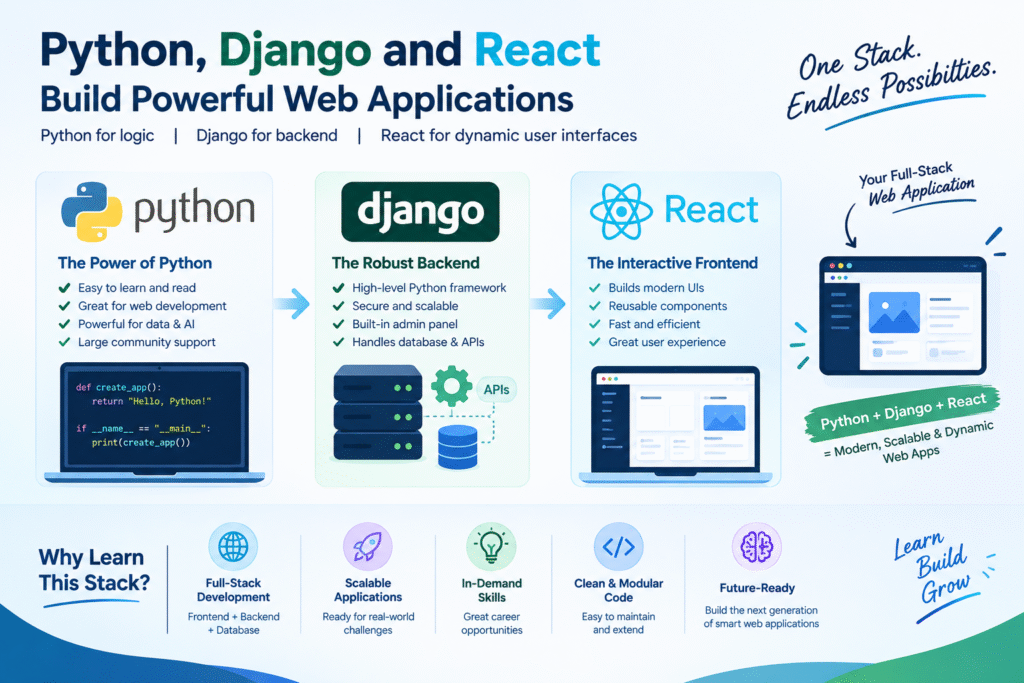
Python, Django, and React are widely used technologies that can work together to create complete web applications.
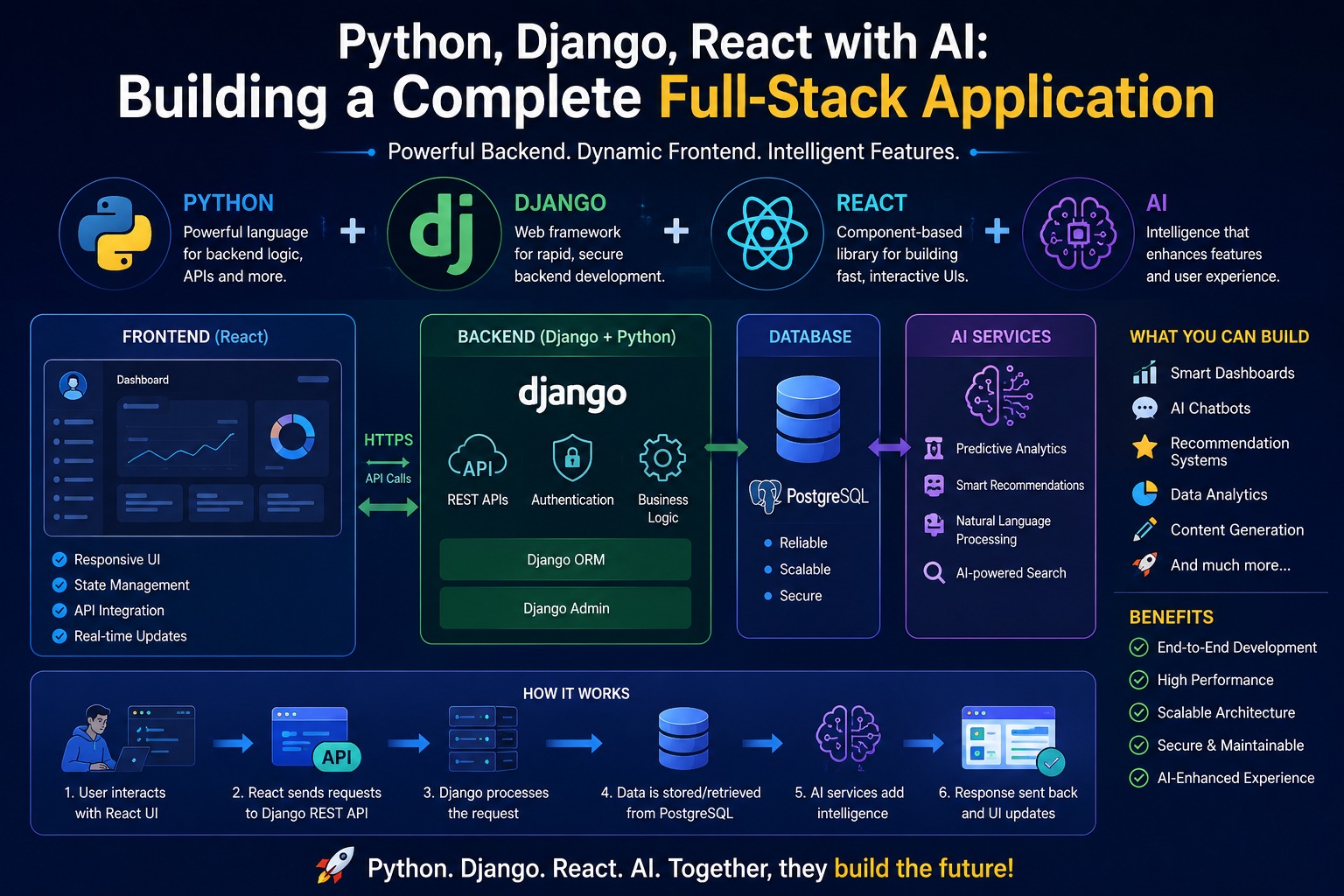
A simple architecture looks like:
React → Django REST API → Python Backend → Database
AI can be integrated into the application to provide intelligent functionality:
React → Django API → Python/AI → Data → Intelligent Results
Each technology has a specific role.
1. Python: The Foundation
Python is a popular programming language known for its readable syntax and wide range of applications.
In a full-stack application, Python can be used for backend programming, automation, data processing, and AI integration.
Python is particularly useful when developing AI-powered applications because of its extensive ecosystem of libraries and frameworks.
Some popular Python libraries include:
- NumPy
- Pandas
- Scikit-learn
- TensorFlow
- PyTorch
Python can therefore serve as a bridge between traditional web development and AI.
Example
Suppose you are building an e-commerce application. Python could process customer and product data and help an AI model generate product recommendations.
2. Django: Building the Backend
Django is a Python-based web framework designed for building robust web applications.
It provides many features that make backend development easier, including:
- URL routing
- Database management
- User authentication
- Form handling
- Security features
- Admin interface
- API development
Django can act as the central backend of a full-stack application.
For example, when a user submits a registration form through a React application, the information can be sent to Django through an API.
Django processes the request and stores the information in a database.
3. React: Creating the Frontend
React is a JavaScript library used to build interactive user interfaces.
React allows developers to create reusable components such as:
- Navigation bars
- Login forms
- Product cards
- Dashboards
- Search interfaces
- Chat interfaces
For an AI-powered application, React can display AI-generated results in an interactive and user-friendly way.
For example, a customer could enter a question into an AI chatbot interface built using React. The request can then be sent to the Django backend for processing.
4. AI: Making Applications Intelligent
Artificial Intelligence adds an intelligent layer to a traditional application.
Instead of simply displaying predefined information, an AI-powered application can analyze information, identify patterns, generate responses, or make predictions.
AI can be used for features such as:
- Chatbots
- Recommendation systems
- Text generation
- Sentiment analysis
- Image recognition
- Predictive analytics
- Personalized content
- Intelligent search
- Automated data analysis
The specific AI technology used will depend on the application requirements.
How Do Python, Django, React and AI Work Together?
Let’s consider an example of an AI-powered learning platform.
Step 1: User Interaction
The user interacts with the application through the React frontend.
For example:
“Create a quiz about Python functions.”
Step 2: API Request
React sends the user’s request to the Django backend through an API.
Step 3: Django Processing
Django receives the request, validates it, manages authentication, and passes the relevant information to the Python/AI layer.
Step 4: AI Processing
The AI system processes the request and generates suitable quiz questions.
Step 5: Response
The generated information is returned through the Django API.
Step 6: React Display
React receives the response and displays the quiz to the user through an interactive interface.
The complete flow becomes:
User → React → Django API → Python/AI → Django → React → User
This architecture allows developers to separate different parts of the application while allowing them to work together efficiently.
Real-World Applications
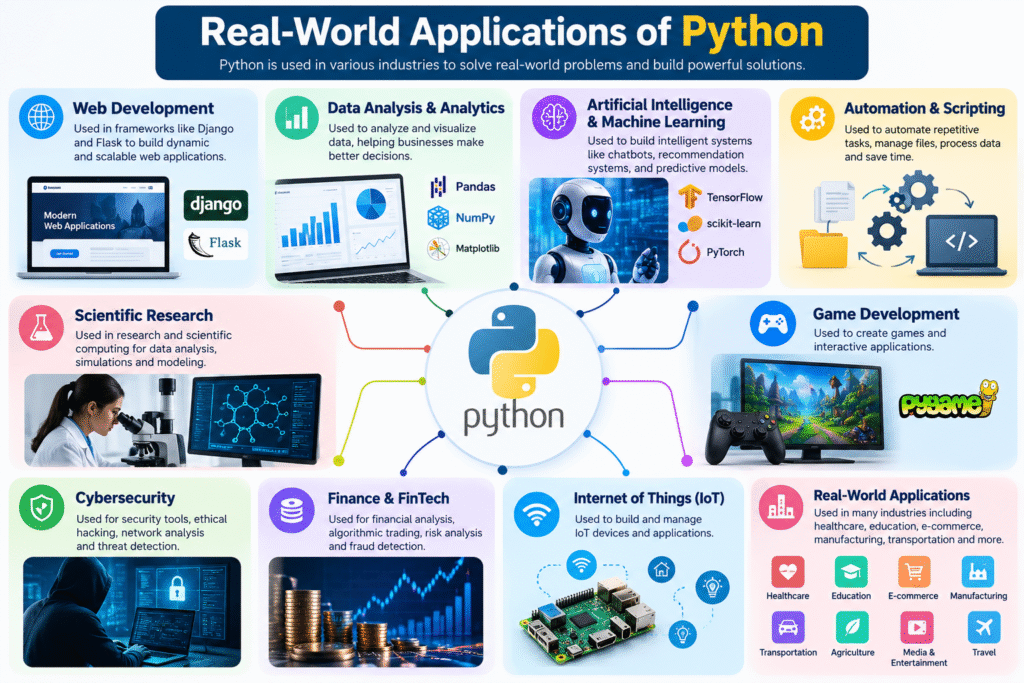
The combination of Python, Django, React, and AI can be used in many industries.
E-Commerce
AI can analyze customer behavior and provide product recommendations.
Education
Applications can use AI to create personalized learning experiences and educational assistants.
Healthcare
Applications can support data analysis and information management, subject to appropriate privacy, safety, and regulatory requirements.
Finance
AI-powered applications can assist with data analysis, forecasting, and fraud-detection workflows.
Customer Service
AI chatbots can help businesses respond to frequently asked questions and provide automated assistance.
Business Analytics
AI can help analyze business data and generate useful insights through interactive dashboards.
Benefits of Learning Python, Django, React and AI
Learning these technologies together can provide developers with a broad understanding of modern application development.
1. Full-Stack Skills
You can understand both frontend and backend development.
2. AI Integration
You can learn how intelligent technologies can be incorporated into applications.
3. Practical Development
Instead of learning technologies independently, you can understand how they communicate within a real application.
4. Scalable Architecture
Separating the frontend, backend, database, and AI components can make applications easier to maintain and extend.
5. Career Development
Knowledge of web development, APIs, Python, and AI can be useful for roles involving software development, full-stack development, backend development, and AI-enabled applications.
Skills to Learn
If you want to build AI-powered full-stack applications, consider developing skills in:
- Python
- Django
- Django REST Framework
- HTML & CSS
- JavaScript
- React
- REST APIs
- Databases and SQL
- Git and GitHub
- AI fundamentals
- Machine Learning basics
- AI API integration
- Authentication and security
- Application deployment
Learning these technologies step by step can help you progress from programming fundamentals to complete application development.
The Future of Full-Stack Development
AI is changing how developers build software. Modern applications are increasingly combining traditional programming with AI-powered features.
However, AI does not replace the need for strong programming fundamentals. Developers still need to understand application architecture, APIs, databases, security, testing, and user experience.
The future of development is likely to involve developers working alongside AI tools to build applications faster while focusing more on solving real-world problems.
Conclusion
Python, Django, React, and AI form a powerful combination for building modern full-stack applications.
Python provides a flexible programming foundation, Django handles backend development and APIs, React creates interactive user interfaces, and AI adds intelligent capabilities.
Together, they allow developers to move from a simple idea to a complete application:
Idea → Python → Django → API → React → AI → Intelligent Full-Stack Application
For students and aspiring developers, learning these technologies together can provide a practical foundation for understanding how modern web and AI-powered applications are designed and developed.