








Software Testing with AI
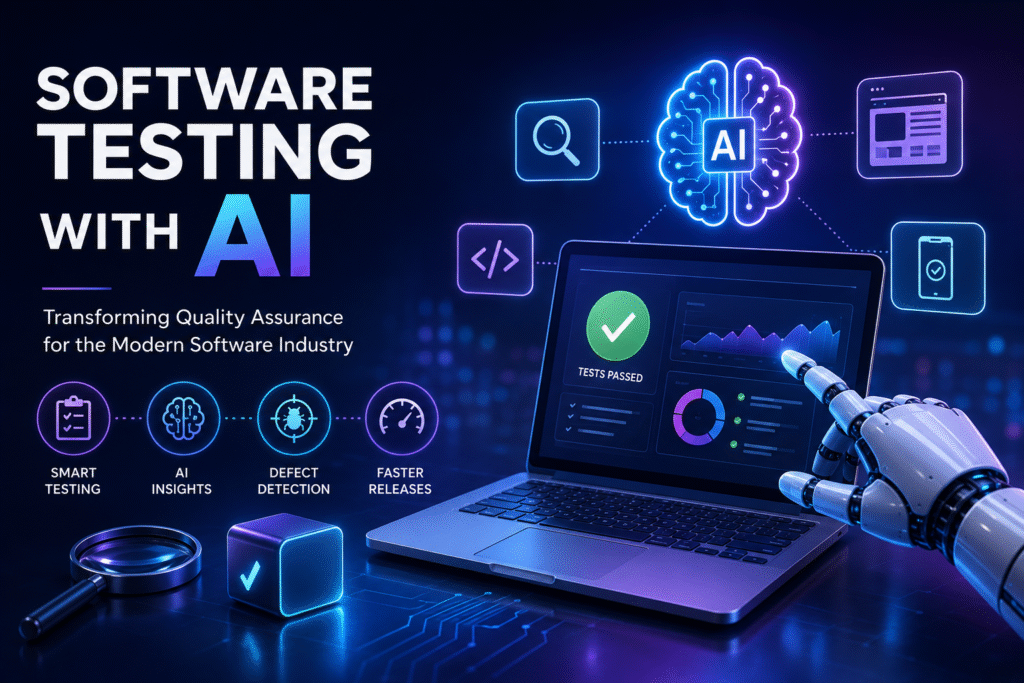
Software Testing with AI: Transforming Quality Assurance for the Modern Software Industry
Software development is evolving rapidly, and businesses are expected to release high-quality applications faster than ever before. Traditional software testing methods, while effective, often struggle to keep pace with agile development, continuous integration, and continuous deployment (CI/CD). This is where Artificial Intelligence (AI) is revolutionizing software testing.
AI-powered software testing enables organizations to automate repetitive tasks, improve test accuracy, reduce execution time, predict defects, and accelerate software delivery without compromising quality.
In this article, we’ll explore what AI-powered software testing is, its benefits, applications, tools, challenges, and best practices.
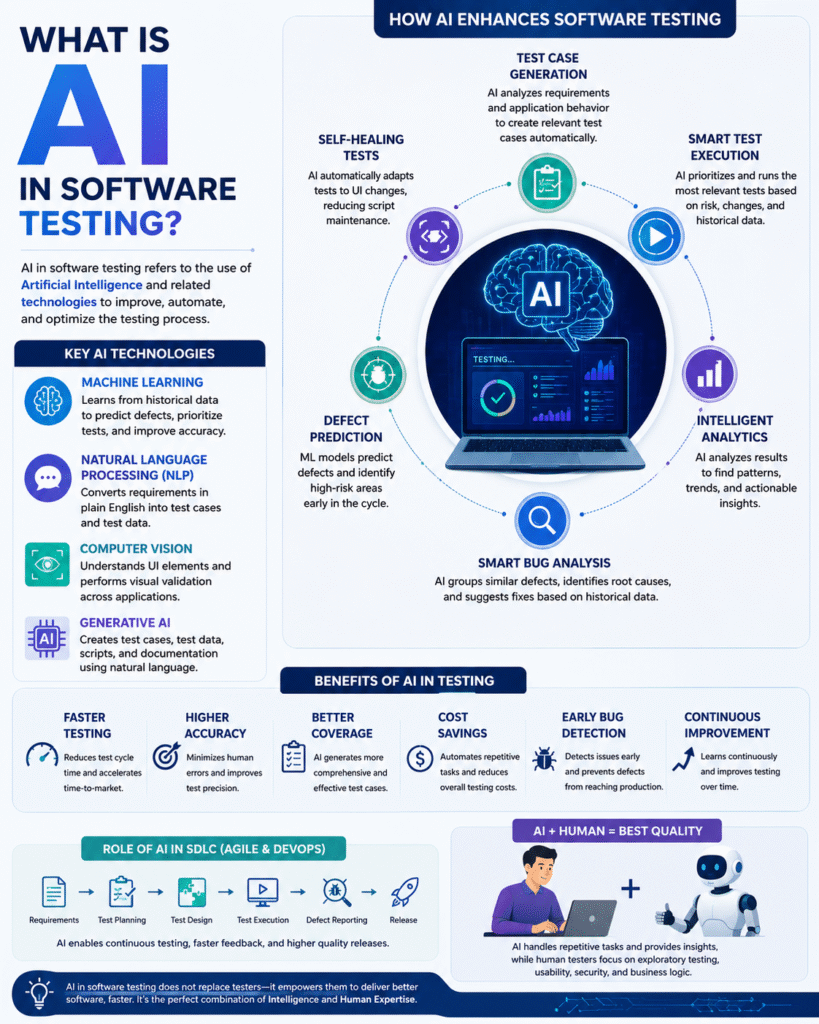
What is AI in Software Testing?
Artificial Intelligence (AI) in software testing refers to the use of advanced technologies such as Machine Learning (ML), Natural Language Processing (NLP), Computer Vision, and Generative AI to improve, automate, and optimize the software testing process. Unlike traditional test automation, which relies on predefined scripts and requires frequent manual updates, AI-powered testing tools can learn from historical test data, application behavior, and user interactions to make intelligent decisions. These systems can automatically generate test cases, prioritize test execution based on risk, detect patterns that indicate potential defects, adapt to changes in the application’s user interface through self-healing capabilities, and analyze test results to provide actionable insights. By reducing repetitive manual work and improving the accuracy and efficiency of testing, AI helps quality assurance (QA) teams deliver reliable software more quickly.
AI is transforming every stage of the Software Development Life Cycle (SDLC), particularly in Agile and DevOps environments where rapid releases are common. It enables continuous testing by identifying the most critical test scenarios, predicting high-risk areas of the application, and reducing the time required for regression testing. AI-powered tools can also analyze large volumes of testing data to identify trends, uncover hidden defects, and recommend improvements to the testing strategy. With the rise of Generative AI, testers can even create test scripts, documentation, and test data using simple natural language prompts, significantly increasing productivity.
Despite its powerful capabilities, AI is not intended to replace human software testers. Instead, it serves as an intelligent assistant that automates repetitive tasks while allowing testers to focus on more complex activities such as exploratory testing, usability evaluation, security validation, and business logic verification. Human expertise remains essential for understanding customer requirements, interpreting AI-generated insights, and making strategic quality decisions. By combining AI with human knowledge, organizations can achieve faster release cycles, higher software quality, reduced testing costs, and a more efficient overall testing process, making AI one of the most significant innovations in modern software quality assurance.
Key Benefits of Learning AI Software Testing
Learning AI-powered software testing offers numerous advantages for both beginners and experienced professionals in the software industry. By combining traditional testing techniques with Artificial Intelligence, learners can automate repetitive tasks, improve testing accuracy, and significantly reduce the time required to validate software applications. AI-powered tools can automatically generate test cases, prioritize test execution, detect defects earlier, and maintain test scripts through self-healing capabilities, allowing QA teams to focus on more strategic and complex testing activities. This leads to faster software releases, better product quality, lower testing costs, and enhanced customer satisfaction. Additionally, learners gain hands-on experience with modern AI testing tools, automation frameworks, Agile methodologies, DevOps practices, and CI/CD pipelines, making them well-equipped to handle real-world software testing challenges. As AI continues to transform quality assurance, mastering AI-driven testing provides a competitive advantage by increasing productivity, improving problem-solving skills, and preparing professionals for the future of intelligent software development.
Career Building Opportunities After This Course
Completing an AI Software Testing course can open the door to a wide range of career opportunities in the rapidly growing software and technology industry. Organizations across sectors such as banking, healthcare, e-commerce, telecommunications, manufacturing, and cloud computing are increasingly seeking professionals who can combine software testing expertise with AI-driven automation. After completing this course, learners can pursue roles such as Software Test Engineer, QA Engineer, Automation Test Engineer, AI Test Automation Engineer, Software Development Engineer in Test (SDET), Quality Assurance Analyst, Performance Test Engineer, API Test Engineer, Test Architect, or DevOps Test Engineer. The skills gained in AI-powered testing also create opportunities to work with emerging technologies, including Generative AI, intelligent automation, cloud testing, and predictive quality engineering. Beyond securing employment, these skills support long-term career growth by enabling professionals to take on technical leadership roles, contribute to digital transformation initiatives, and remain relevant in an industry where AI is becoming a standard part of the software development lifecycle. With growing demand for AI-enabled quality assurance professionals worldwide, this course can serve as a strong foundation for building a rewarding, future-ready career in software testing.
Software testing is an important part of software development. It helps find and fix bugs before the software is released, making the application more reliable, secure, and user-friendly.
In this course, we learned the basics of software testing, including testing types, testing levels, test cases, defect reporting, and automation. These concepts help ensure that software works correctly and meets user requirements.
Overall, software testing improves software quality, reduces errors, saves time and cost, and increases customer satisfaction. The knowledge gained from this course provides a strong foundation for anyone who wants to build or test high-quality software.